

Office Diffusers and Draughts: Why the Jet Drops, and How to Stop It
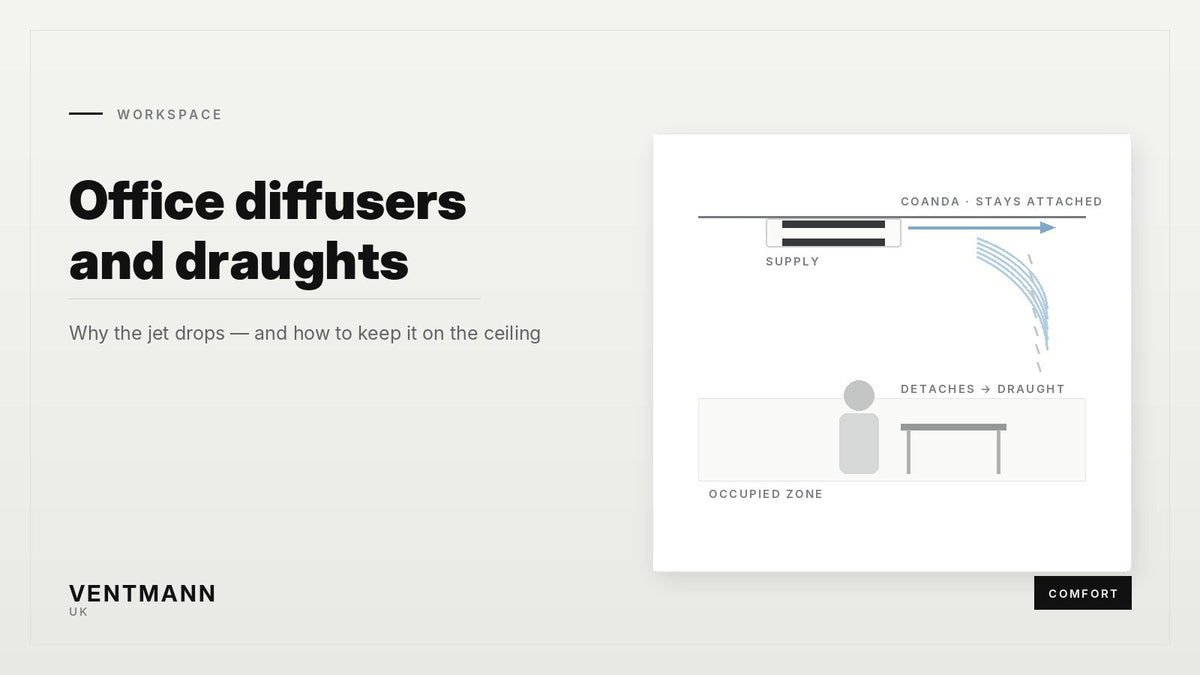
Almost every open-plan office has a cold desk. Someone sits under a diffuser, puts a cardigan on the back of their chair in June, and emails facilities about the air conditioning. The system is usually working exactly as designed — which is the problem. Here is why draught complaints happen at the terminal, and how to specify them out.
The short version
A draught complaint is almost never about temperature. It is about air velocity at head and shoulder height, and it is decided by diffuser geometry, not by the chiller.
The fix is to keep the supply jet attached to the ceiling for longer and let it mix before it drops. That means more free area, lower face velocity, and a profile designed to work the Coanda effect.
What people actually feel
Occupants report "draught" when moving air strips heat from exposed skin faster than the surrounding air temperature alone would. Two things drive it: the speed of the air, and how much cooler it is than the room. In a cooling season that second factor is fixed by the design — supply air is cooler than the room by definition. So velocity is the lever you have.
Crucially, people sense fluctuating air far more readily than steady air. A jet that detaches from the ceiling, wanders, and dumps intermittently over a workstation is noticed at velocities well below a steady flow of the same average speed. Which is why a terminal that performs perfectly in a test rig can still generate complaints in a real office with partitions, beams and a changing load.
Why the jet drops
A supply jet leaving a ceiling diffuser wants to stay attached to the ceiling. That is the Coanda effect: the jet entrains room air, pressure drops between the jet and the surface, and the surface holds it. While it is attached it keeps mixing, losing velocity and gaining temperature, so by the time it reaches the occupied zone it is slow and close to room temperature.
It detaches when any of the following happen:
- Velocity falls too far. Counter-intuitively, too little momentum causes cold air to separate and fall early. Over-sizing a diffuser is a real failure mode, not a safe margin.
- Something interrupts the ceiling. A downstand, a beam, a bulkhead, a run of acoustic rafts, a pendant light. The jet reaches the obstruction and drops straight down behind it.
- The throw is too long for the room. Two opposing jets that were supposed to meet and rise instead collide and fall into the middle of the floor plate.
- The system modulates down. At 40% of design flow a VAV system can push a diffuser below the velocity it needs to stay attached, so the complaints arrive on mild days rather than hot ones.
Specifying to avoid it
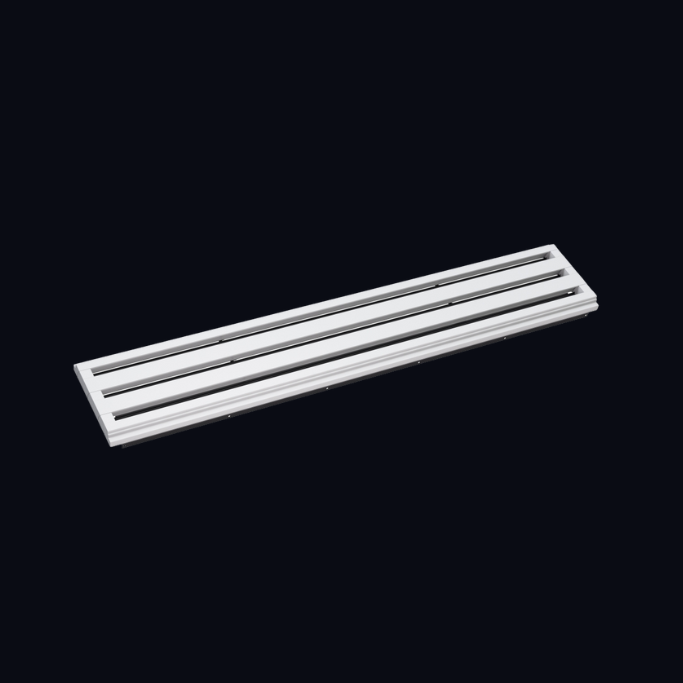
The Performance Line diffuser is built around this problem. Its curved inner face attaches the jet far more effectively than a flat slot, spreading supply air wide and at low perceptible velocity rather than projecting a concentrated stream. In an open-plan floor plate that is the single most useful property a terminal can have.
Three decisions follow from it.
1. Choose length before you choose slot count
A longer diffuser spreads the same volume over a wider arc of ceiling, which reduces both face velocity and throw. Use the full run the reflected ceiling plan allows — up to 1250 mm per unit, and units can be lined up to read as a continuous line.
2. Add slots when you need free area, not by default
Going from two slots to three drops face velocity again, which is right for a dense cooling load or a tight dB(A) target. But it also shortens throw. On a deep floor plate or above a 3 m ceiling, three slots can leave a stagnant zone at the far end. The trade-off table is in our diffuser sizing guide.
3. Use the perforated deflector over occupied seats
The Performance Line is available with a standard deflector, a perforated deflector, or none. The perforated option softens the discharge further and is the right call where a terminal unavoidably sits above a desk — a meeting room table, a reception position, a cellular office.
The over-sizing trap. Faced with a draught complaint, the instinct is to specify a bigger diffuser or more slots everywhere. Past a point that makes it worse: the jet loses the momentum it needs to stay on the ceiling, separates early and dumps cold air closer to the occupant than before. Size to the duty, do not pad it.
Layout rules that matter more than the product
| Situation | What to do |
|---|---|
| Downstand or beam in the ceiling | Treat it as the end of the throw. Do not expect a jet to cross it. |
| Desks against a glazed façade | Run the diffuser parallel with the façade, discharging across the glass, not down onto the desks. |
| Opposing diffusers | Check combined throw. Two jets meeting at full velocity fall into the occupied zone. |
| Cellular offices cut out of open plan later | Re-check each room's terminal. A diffuser sized for open plan is usually over-sized for a 3 m × 4 m office. |
| Acoustic rafts or baffles | They interrupt the ceiling surface. Coordinate them with the slot positions, not after. |
| VAV or demand-controlled systems | Check performance at turndown as well as at design, not just at 100%. |
Cat A, Cat B and the diffuser you inherit
A particular problem in UK office fit-out: the Cat A installation is designed for an empty floor plate on a generic grid. Cat B then puts in meeting rooms, a tea point, a phone booth and a bank of desks — and nobody re-checks the terminals against the layout they now serve.
If you are doing Cat B work in a space that already has architectural diffusers, the questions are: does any terminal now sit over a seated position; has any new partition or bulkhead cut a throw short; and has any room ended up with a terminal sized for ten times its volume. Those three checks catch most of what would otherwise become a facilities ticket in month two.
Where the plan changes significantly, the plaster-in nature of these terminals means moving one is a ceiling job. Resolve it on the drawing — see our note on getting diffusers into the model early.
What the ceiling gets out of it
The reason offices specify gypsum slot diffusers in the first place is visual. On a plastered ceiling the terminal becomes a shadow line that reads with the lighting rather than against it, with no frame, no visible fixing and no white rectangle in the middle of an exposed soffit scheme. Painted in the ceiling colour it is close to invisible.
Where the office has a demountable grid ceiling, that argument disappears and a conventional metal grille sized to the tile module is the sensible answer. The honest version of that comparison is here.
Common questions
What air velocity is acceptable in the occupied zone?
Design guidance generally targets low mean velocities in the occupied zone during cooling, with tighter limits where occupants are sedentary. Work to the figure in the project's own comfort criteria or the current CIBSE guidance rather than a rule of thumb, and remember that fluctuation matters as much as the mean.
Can you retrofit without replacing the diffuser?
Often, yes. Rebalancing the branch, fitting an adjustable damper or an airflow regulator upstream, or changing the deflector will resolve a surprising number of complaints without touching the ceiling.
Do slot diffusers work with displacement or chilled beams?
They are designed for mixing ventilation. If the strategy is displacement, the terminal logic is different and a low-level solution is appropriate instead. Tell us the strategy and we will say honestly whether our ranges fit it.
Are they suitable for extract as well as supply?
Yes, and extract is the easy case — throw and comfort are irrelevant, so you are buying the look. A standard Line diffuser is usually the economic choice on extract.
Draught complaints on a live floor, or a new fit-out to specify?
Send the floor plan, the RCP and the design rates. We will check throw against the layout and tell you which terminals need changing — and which do not.
Request a free quotation · Workspace solutions · Product selector
Related ranges: Performance Line · Line · Performance Circle · Square · Fittings & dampers