



Picking the Plenum Box: GTG vs VTBOX for Linear Slot Diffusers
The plenum box is the part of a linear diffuser installation nobody photographs and everybody gets wrong. Pick the wrong one and you either cannot physically connect the duct, or you connect it and the room hums. Here is how to choose between the GTG acoustic box and the VTBOX insulated thermo box — and why the decision is usually made for you by the ceiling void, not by preference.
The one-line version
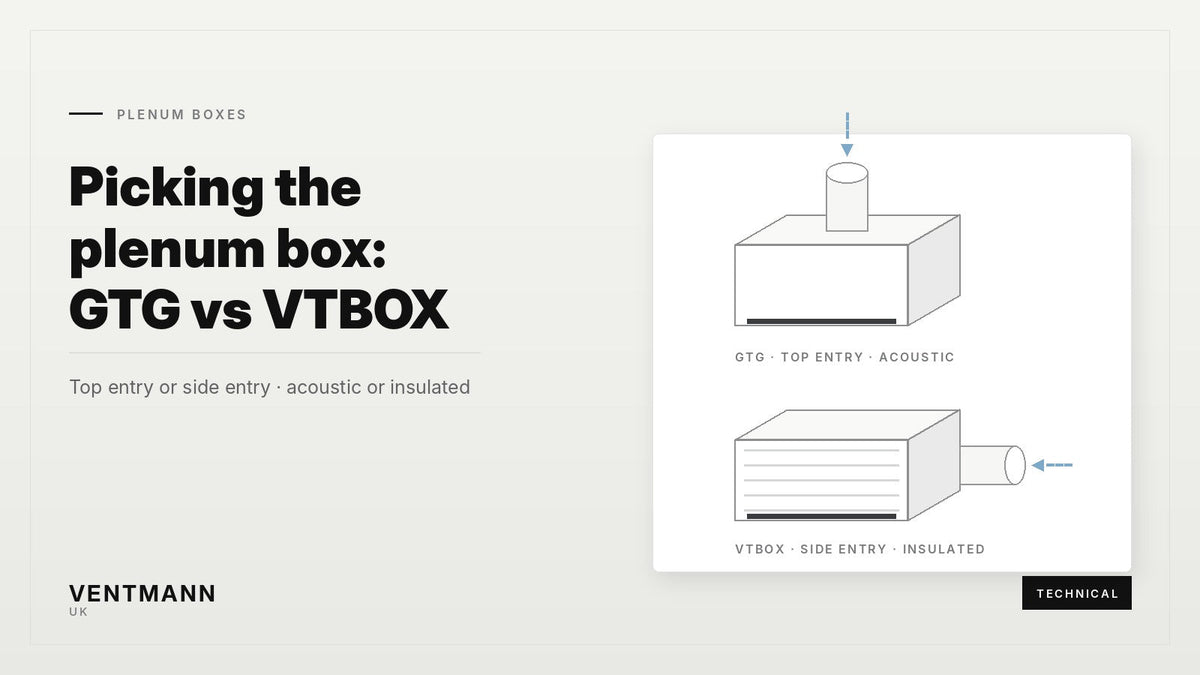
Duct drops in from above? GTG acoustic box — top entry, acoustic foam lined, from £85.41.
Duct arrives from the side? VTBOX thermo box — V-shaped, side entry, insulated, from £94.58.
What a plenum box is actually doing
A plenum box takes a round, fast-moving air stream from a circular duct and turns it into a slow, even pressure field across the whole back of a linear slot. Without one, air arrives at the slot concentrated over the spigot and the diffuser discharges unevenly — fast at one end, nothing at the other, and audibly.
It is also where noise is dealt with. Fan noise and duct-borne noise travel to the room through the diffuser aperture; the plenum is the last chance to absorb it. And in a cold roof void or a warm plant space, it is where condensation either happens or does not.
Those three jobs — even pressure, acoustic attenuation, thermal protection — are why there are two boxes rather than one.
Side by side
| GTG Acoustic Box | VTBOX Thermo Box | |
|---|---|---|
| Duct entry | Top (vertical drop) | Side / lateral (horizontal run) |
| Primary benefit | Acoustic foam insert — attenuates duct-borne noise | Insulated V-profile — thermal regulation, condensation control |
| Spigot knock-outs | Ø75, Ø125, Ø160 mm | Ø125, Ø160, Ø200 mm |
| Lengths | 625, 1000, 1250 mm | 625, 1000, 1250 mm |
| Width codes | A, B, C | A, B, C |
| Supplied as | Assembled, with pre-scored knock-outs | Flat packed — folds and screws together on site (SQ2 bit) |
| From (ex VAT) | £85.41 | £94.58 |
| Suits | Ventmann Line and Performance Line slot diffusers — width code must match the diffuser | |
| Warranty | 5 years | |
Decision one: top entry or side entry?
This is not a preference. It is dictated by how much depth you have between the finished ceiling and the structure above, and by the direction your branch runs.
Choose top entry (GTG) when
- There is a usable void above the box — typically 250 mm or more to get the flexible duct turned and onto the spigot without crushing it.
- The branch comes off a main that runs perpendicular to the diffuser, so a vertical drop is the natural connection.
- You are running MVHR or an AC branch and noise transmission is the thing you are most worried about.
- The diffuser sits away from joists, so a drop is unobstructed.
Choose side entry (VTBOX) when
- The void is shallow — a service zone squeezed under a slab, a dropped bulkhead, a loft conversion between joists.
- The duct runs parallel with and alongside the diffuser, which is the usual case in a corridor or a perimeter bulkhead.
- The box sits in a cold roof void or an unheated zone and you need the insulation to stop condensation forming on a chilled supply.
- You need a Ø200 connection — the VTBOX takes it, the GTG does not.
Common site error: ordering GTG boxes because they are £9 cheaper, then discovering the duct cannot physically drop in. Changing a plenum at second fix means cutting a finished ceiling. Resolve entry direction at coordination stage, not on site.
Decision two: acoustic or insulated?
Most of the time this decision is made for you by the first one — GTG is the acoustic box, VTBOX is the insulated box. But it is worth knowing which problem you are actually buying out of.
The acoustic problem
A slot diffuser is an open aperture into a duct. Fan noise, turbulence at bends, and crosstalk between rooms all arrive through it. The GTG's foam insert sits inside the box and absorbs mid and high frequency energy before it reaches the slot. In bedrooms, hotel rooms, consulting rooms, studies and anywhere with an NR target, that insert is the difference between a system that is noticed and one that is not.
If you need more attenuation than the box alone provides, add an inline foam damper upstream (from £8.29) and run the last 1–2 m in acoustic flexible ducting rather than rigid.
The thermal problem
Push air at 14 °C through an uninsulated steel box sitting in a 24 °C humid void and the box surface will reach dew point. The water has to go somewhere, and in a gypsum ceiling it goes into the board. The VTBOX's insulated V-profile keeps the metal above dew point and keeps supply temperature where the designer intended it rather than giving away cooling to the roof space.
Any comfort-cooling branch in an unconditioned void should be on a VTBOX, whichever way the duct arrives. If geometry forces a top entry in that situation, insulate the GTG externally and insulate the spigot connection properly — do not leave it bare.
Decision three: width code A, B or C
Both boxes come in three width codes. This is not a free choice — the code must match the diffuser you have specified. A 1-slot diffuser, a 2-slot and a 3-slot have different back widths, and the plenum has to seal against the right one.
Order the diffuser first, note its width code, and order the matching plenum in the same length. If you are buying diffuser and plenum together from Ventmann they are supplied pre-assembled, which removes the risk entirely and saves an awkward job at first fix.
Spigot sizing: pick the knock-out before you order
Both boxes ship with three pre-scored knock-outs so the installer selects the size on site and fixes the spigot with tech screws and sealant. Useful flexibility, but it does mean someone has to make the decision — and knocking out the wrong one is not reversible.
| Spigot | Sensible duty at 3–4 m/s | Available on |
|---|---|---|
| Ø75 mm | ~48–64 m³/h | GTG |
| Ø125 mm | ~130–175 m³/h | GTG and VTBOX |
| Ø160 mm | ~215–290 m³/h | GTG and VTBOX |
| Ø200 mm | ~340–450 m³/h | VTBOX only |
Duty figures are duct velocity arithmetic for sizing guidance, not diffuser performance data. For throw, pressure drop and dB(A), use the product selector or the technical catalogue.
A note on Art frameless grilles
If you are specifying Art frameless grilles rather than slot diffusers, neither GTG nor VTBOX applies — they take the dedicated Art plenum box (from £92.00), sized to the grille.
The five-question checklist
- Which direction does the branch arrive from? → sets GTG or VTBOX.
- Is the void conditioned? → if not, and the branch is cooling, insulate regardless.
- Is there an NR or dB(A) target in the room? → GTG, plus inline attenuation if tight.
- What width code is the diffuser? → match it exactly.
- What flow rate is the branch carrying? → sets the spigot knock-out.
Answer those five at coordination and the plenum stops being a problem. Full fitting sequence is in the plenum box installation guide, and the Line diffuser installation page walks through the pre-assembled diffuser-and-plenum method step by step.
Not sure which box your project needs?
Send the RCP and the branch layout. We will mark up which positions need top entry and which need side entry, and quote the matched sets.
Request a free quotation · Browse plenum boxes · +44 (0)1283 240025
Where to go next
- Sizing a diffuser from your design rates — getting the spigot right before you order
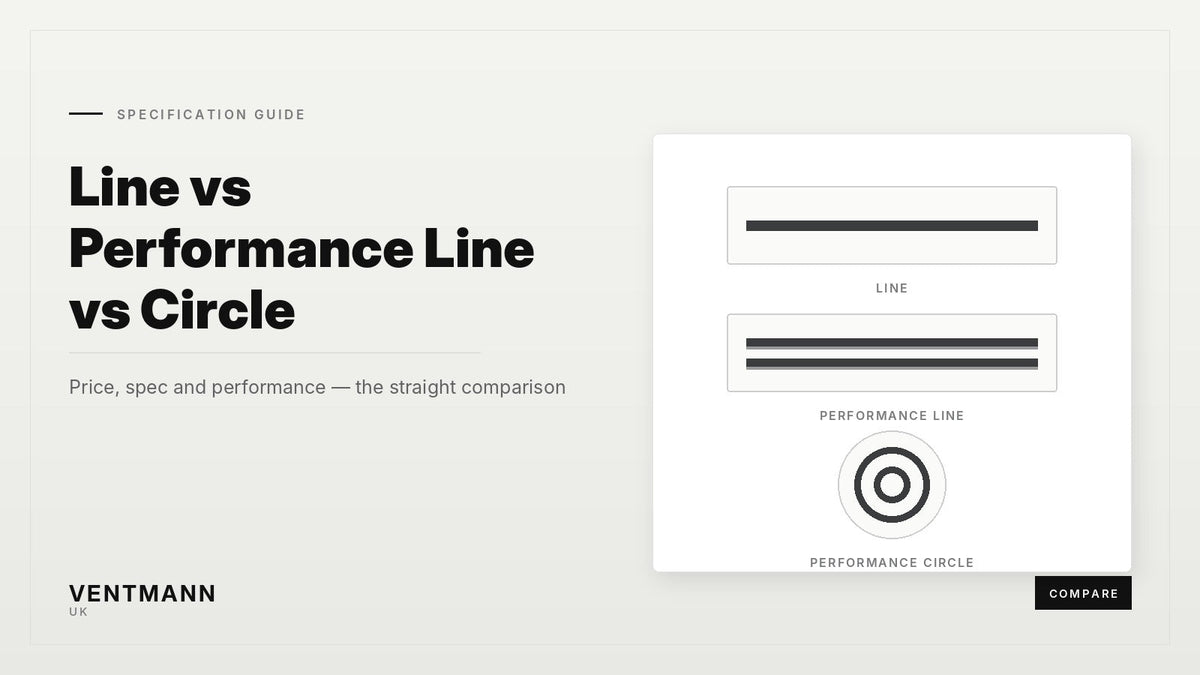
- Line vs Performance Line vs Circle — choosing the diffuser the plenum sits behind
- Apartment schemes at scale — why shallow service zones decide this for you
- BIM and coordination — modelling the plenum envelope, not just the box