



Round Ceiling Diffusers and Circular Ceiling Vents: Sizes, Types and How to Choose

The round ceiling diffuser is the default terminal of domestic ventilation: one per room, 100 or 125 mm, screwed to the ceiling. It is also the terminal with the widest quality range on the market, from a plastic cone valve to a plaster-in gypsum diffuser that disappears into the ceiling. This guide covers the types of round and circular ceiling vent, the spigot sizes, how to size one for the room, and how a frameless version is installed and adjusted.

A circular plaster-in diffuser in a kitchen ceiling. After painting it reads as a shadow ring, not a vent.
Types of round ceiling diffuser
| Type | Construction | Air pattern | Where it is used |
|---|---|---|---|
| Plastic cone valve | Push-fit collar, adjustable centre cone | Ring jet, downwards | Budget MVHR and extract fans |
| Metal ceiling valve | Painted steel cone and ring | Ring jet, downwards | Better-finished MVHR installs |
| Metal round diffuser | Concentric cones or louvres, 150–300 mm | Radial or downward | Commercial ceilings, larger duties |
| Frameless gypsum circular diffuser | Plaster-in body, paintable, Coanda profile | Radial, attached to the ceiling | Homes, hotels, offices — wherever the ceiling is designed |
Why the air pattern matters more than the size
A cone valve pushes air down in a ring; whoever is beneath it is in the airstream. A Coanda profile turns the air outwards so it clings to the ceiling and spreads across the room, mixing as it goes, before descending gently at the walls. The flow rate is the same; the experience in the room is not. For bedrooms and anywhere people sit still, the Coanda pattern is the one to specify. The Coanda air diffuser article explains the physics.
Performance Circle Diffusers
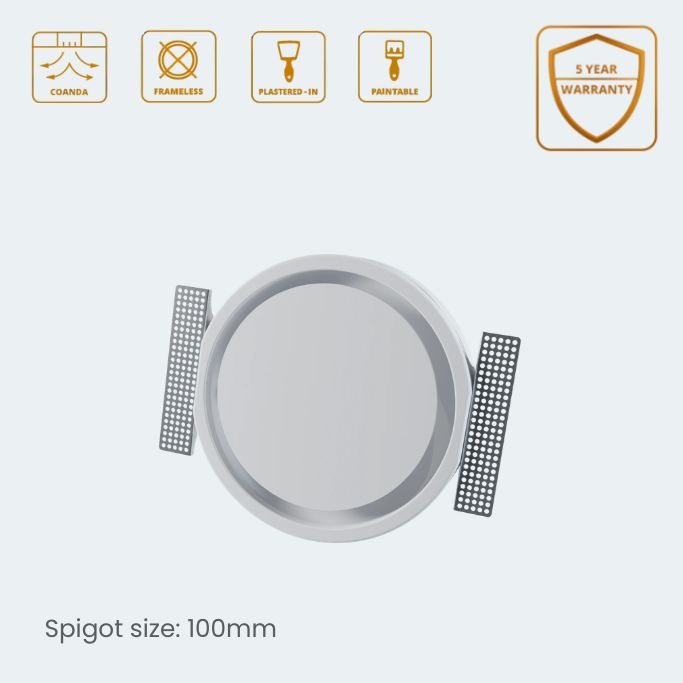
The circular frameless terminal. Curved internal geometry turns the supply air outwards along the surface (the Coanda effect), giving wide dispersal and almost no perceptible airflow directly below. Four spigot sizes cover everything from an MVHR bedroom branch to a cooled open-plan space.
- Shape Circular, frameless, plaster-in
- Slots 1 or 2
- Spigot sizes 100, 125, 160 and 200 mm
- Material Gypsum, supplied white, fully paintable
- Duty Supply or extract, heating and cooling
- Price From £86.65 excl. VAT
Spigot sizes: 100, 125, 160 and 200 mm
The spigot size follows the flow rate the room needs, not the room's floor area. The usual pattern on domestic MVHR is 100 mm for bedrooms, bathrooms and small rooms and 125 mm for larger habitable rooms; 160 and 200 mm appear on comfort cooling and in commercial spaces, where one terminal carries more air. Where the duty per terminal is high, the two-slot version adds free area so the face velocity — and the noise — stays down.
| Spigot | Slots | Typical duty |
|---|---|---|
| 100 mm | 1 | Bedrooms, bathrooms, en-suites, studies on MVHR branches |
| 125 mm | 1 | Living rooms, hotel rooms, small offices |
| 160 mm | 1 or 2 | Open-plan rooms, comfort cooling, meeting rooms |
| 200 mm | 1 or 2 | Higher duty per terminal, commercial and retail |
150 mm ducting? UK MVHR and extract systems are commonly run in 100, 125 and 150 mm duct. A 150 mm branch connects to the 160 mm spigot with a reducer or coupler from the fittings range; 160 is the nominal diffuser size at that duty.
Round ceiling vent covers: the replacement question
A lot of searches for round ceiling vent covers come from people replacing a yellowed plastic valve. The honest answer is that a frameless diffuser is not a drop-in cover — it is a terminal that plasters into the board — but on a repaint or refurbishment it is the moment to make the change: cut the opening to the body size, fix, skim and paint. The result is a ceiling with no visible vent at all, in whatever colour the ceiling is painted.
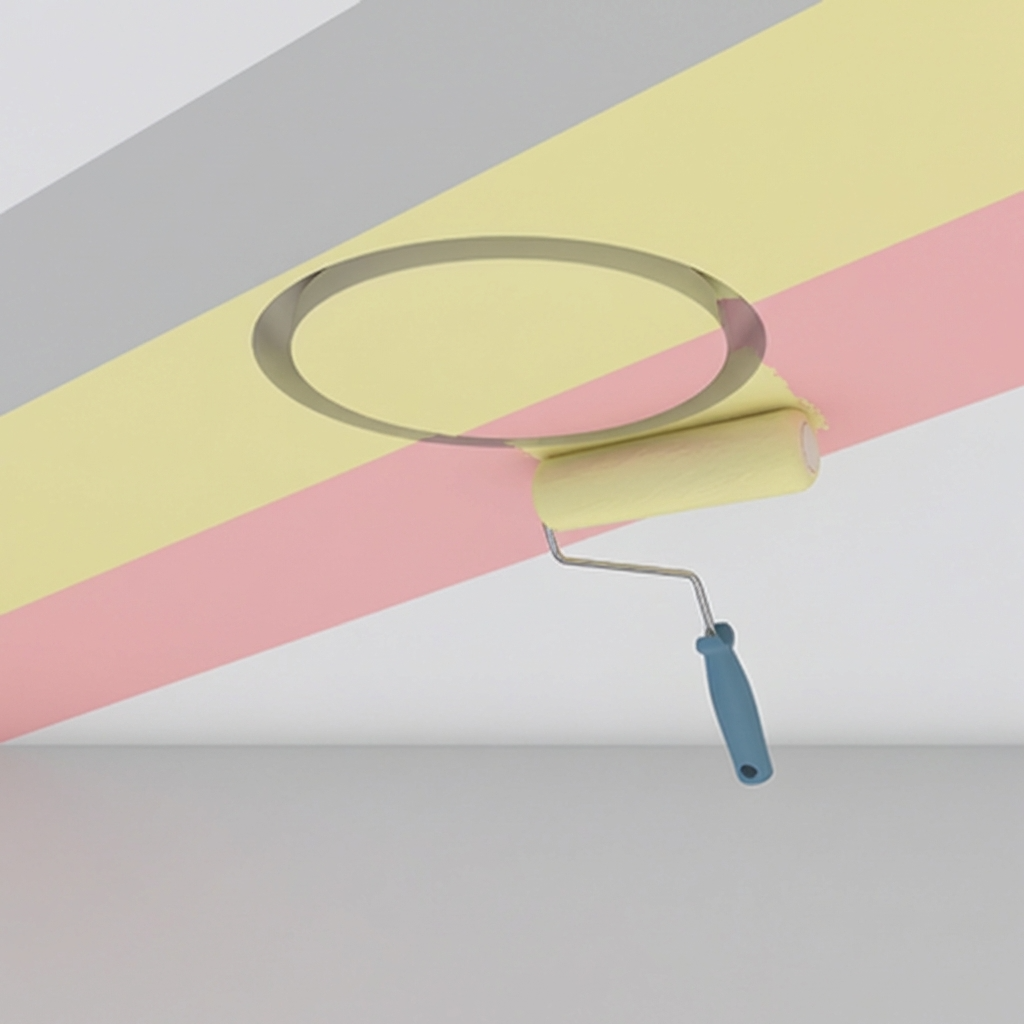
Supplied white, painted last: the round diffuser takes whatever colour the ceiling takes.
Installing a round frameless diffuser
- Drop the duct to the terminal position before the board goes on.
- Cut the opening to the body diameter plus about 10 mm — not the duct diameter.
- Fix the body through its side brackets to the plasterboard and connect the duct to the spigot.
- Hang the cap, which carries a safety cable so it cannot be dropped or lost on site.
- Skim the flange into the board with jointing compound, sand flush, and paint with the ceiling.
The PCIRCLE installation page has the step drawings; the whole job is a plasterer's detail rather than a ventilation engineer's.
Adjusting and balancing a round diffuser
A cone valve is adjusted by screwing the centre in or out, which changes the flow rate and the noise at the same time. A frameless Coanda diffuser is designed to run with its face open and to be balanced upstream: an inline foam damper in the branch sets the flow for the room, and the terminal stays quiet. On the Square Diffuser, magnet-held blocks allow the air pattern to be tuned after painting; on the circle, the pattern is fixed by the profile and the second slot is the flow adjustment.
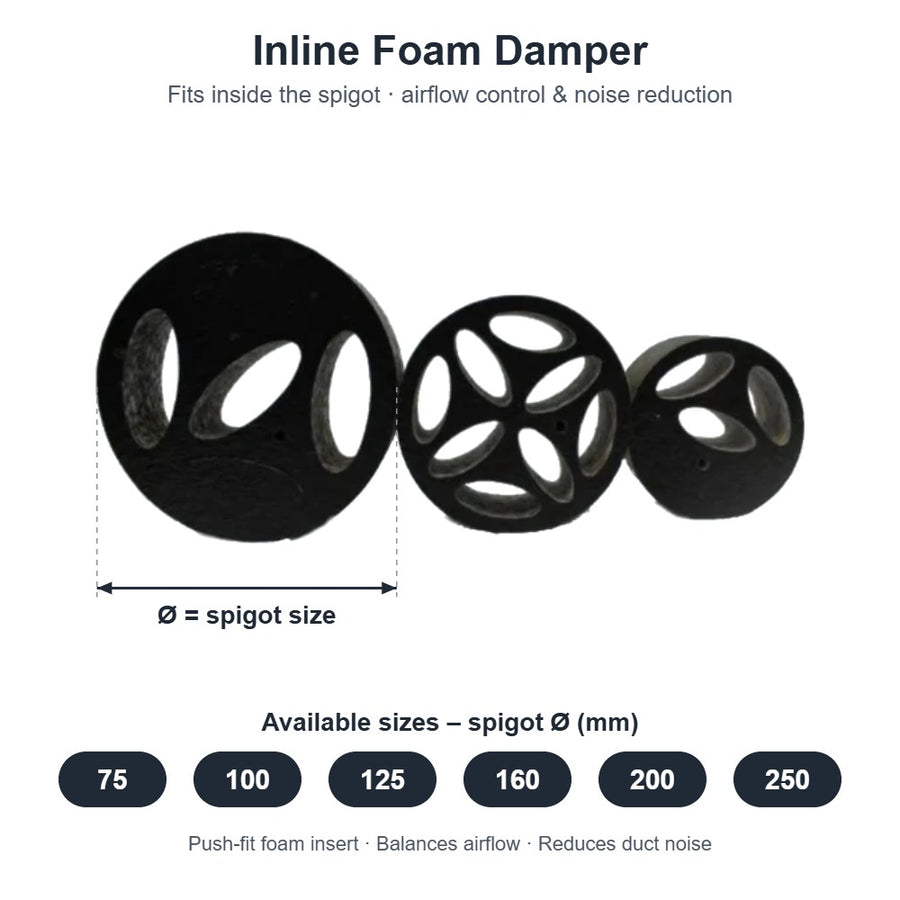
Inline Foam Damper
Trim an over-blowing branch in the duct, not at the terminal. Closing a diffuser face down is exactly what reintroduces the hiss a frameless profile is shaped to avoid.
- Spigot sizes 75, 100, 125, 160, 200 and 250 mm
- Fit One per branch, in an accessible length of duct
- Price From £8.29 excl. VAT
Square, wall-mounted and decorative alternatives
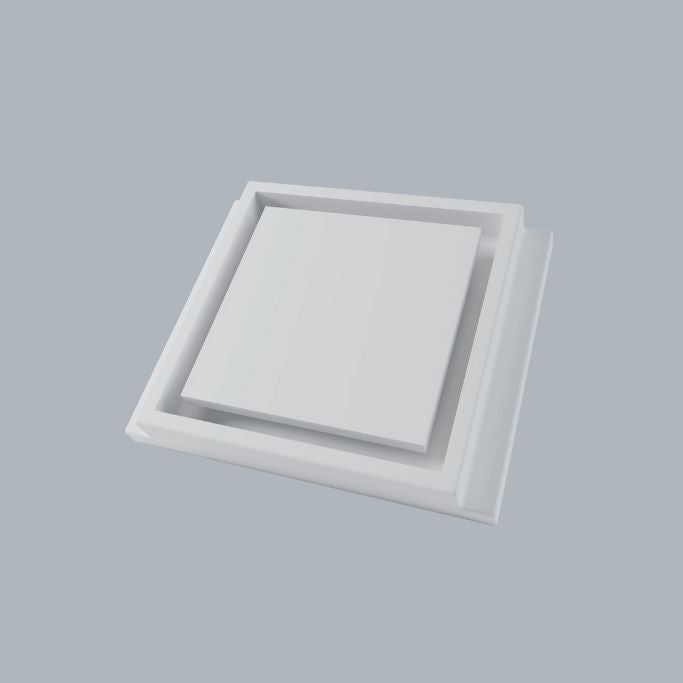
On a gridded ceiling the Square Diffuser gives the same plaster-in detail in a square face at 100 and 125 mm. Where there is no ceiling void, the Side Round puts a circular terminal in the wall with spigots up to 250 mm. For return-air openings and fireplaces, the ART frameless grilles add a laser-cut pattern inside a gypsum surround.
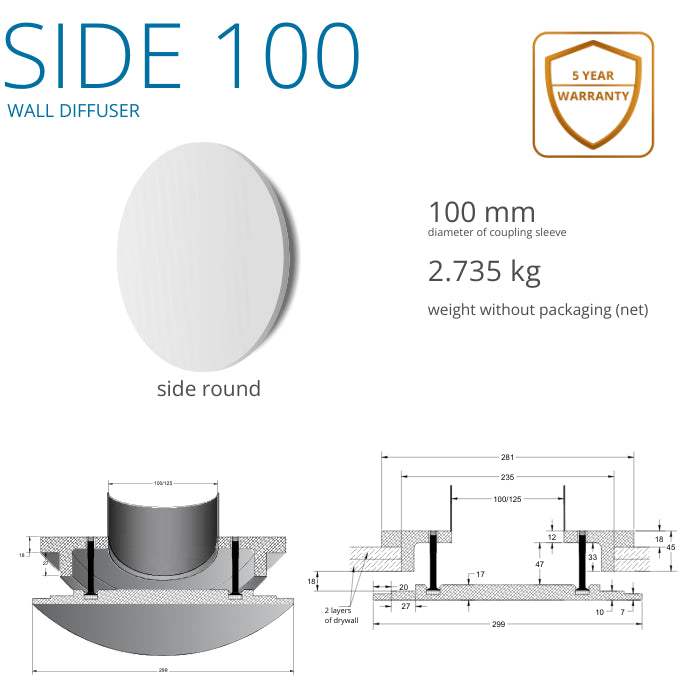
Side Round Diffuser
For rooms with no ceiling void. A frameless round terminal that plasters into a wall (or ceiling) and throws air along the surface, with an adjustable gap height to change the air speed. Five spigot sizes up to 250 mm.
- Spigot sizes 100, 125, 160, 200 and 250 mm
- Adjustment Gap height sets the airflow speed
- Mounting Wall or ceiling, plaster-in
- Material Gypsum, supplied white, fully paintable
- Price From £122.37 excl. VAT
Frequently asked questions
What does a round ceiling diffuser do?
It delivers supply air from a duct into the room in a radial pattern — or removes extract air — at a speed and spread that keeps the room comfortable and quiet. Coanda versions attach the air to the ceiling so nobody underneath feels it.
How do I adjust a round ceiling diffuser?
A cone valve is adjusted by turning its centre, which changes both flow and noise. A frameless Coanda diffuser runs open and is balanced in the duct with an inline damper; use the two-slot version where the duty is higher.
What size round ceiling diffuser do I need?
It follows the room's design flow rate. On domestic MVHR, 100 mm for bedrooms and bathrooms and 125 mm for larger rooms are typical; 160 and 200 mm for cooling and commercial duties. Send the plans and Ventmann will size it free.
Can a round ceiling diffuser be painted?
A gypsum plaster-in diffuser is designed to be, with emulsion or spray paint after installation. Metal valves need powder-coating to order.
What is the cut-out for a round frameless diffuser?
The body diameter plus roughly 10 mm (A + 1 cm on the drawing). Take the body diameter for your spigot size from the product drawing; it is not the duct diameter.
Round or square?
Performance is equivalent at the same spigot size; the choice is architectural. Round suits plain ceilings and single points; square suits gridded layouts and lines up with square lights.
Not sure which terminal you need?
Send us your floor plan and we will run the airflow calculations, size every diffuser, plenum and damper, and get the kit to you with next-day UK delivery — free.
Call 01283 240025 · Email sales@ventmann.co.uk
Shop Performance CircleGet Free Airflow Calculations