




Frameless Ventilation Valves: The Complete UK Guide (Round, Square & Linear)

A frameless ventilation valve is an air valve with no visible rim: the body is plastered into the ceiling or wall, the face sits flush with the finished surface, and the only thing you see is a shadow line. This guide covers the frameless ventilation valves available in the UK — round, square and linear — with the sizes, airflow rates, Part F duties and installation detail you need to specify one correctly the first time.
The short answer
Choose a frameless ventilation valve when the terminal must disappear. Pick the shape by the ceiling (round reads as a shadow ring, square suits grid and geometric layouts, linear suits long runs and air conditioning), pick the spigot by the air volume the room needs under Approved Document F, and pick the material by how it has to be finished — gypsum takes plaster and paint, plastic does not. Everything below is the detail behind those three decisions.
What is a frameless ventilation valve?
A conventional air valve — the white plastic disc valve on almost every UK bathroom ceiling — has a flange that sits on the surface. It is quick to fit, it is cheap, and it is permanently visible. A frameless ventilation valve inverts that logic: the carrier ring is fixed to the duct and the plasterboard before skimming, the plaster is brought right up to the edge of the valve, and the centre cap drops in afterwards. There is no flange, no shadow gap full of dust, and nothing to catch the eye when you look up.
Because the body becomes part of the ceiling, a frameless valve is painted with the ceiling. It takes the same emulsion, the same colour and the same sheen, so it reads as a detail rather than a fitting. That is the whole proposition: ventilation you specify for performance and never have to look at.
Frameless valve vs standard disc valve
| Standard disc valve | Frameless ventilation valve | |
|---|---|---|
| Visible rim | Yes — plastic flange on the surface | None — flush with the plaster |
| Finish | Factory white plastic | Plastered and painted with the ceiling |
| Fitted | After decoration, in minutes | Before skim — coordinated with the plasterer |
| Adjustment | Screw-adjust centre cone | Adjustable gap height / airflow pattern |
| Where it belongs | Lofts, plant rooms, utility cupboards | Habitable rooms, bathrooms, kitchens, hotels, retail |
Supply or extract — the same valve does both
Frameless valves are not direction-specific. The same unit works as a supply valve bringing filtered fresh air into a bedroom or living room, and as an extract valve pulling humid air out of a bathroom, en-suite, WC or kitchen. Only the duty changes. On an MVHR system you will typically have both on the same ceiling plane, which is exactly where a visible plastic valve gives the game away — and where a frameless one does not. We make that case at length in MVHR Deserves Better Than a Plastic Valve.
The four types of frameless valve
1. Round frameless ventilation valves
The classic plaster-in air valve, and the direct replacement for a disc valve. Ventmann's Performance Circle Diffusers are frameless circular valves in a gypsum composite, available with 100, 125, 160 and 200 mm spigots in one- or two-slot configurations. The slot geometry exploits the Coanda effect — the air leaving the valve clings to the ceiling and spreads sideways instead of dropping as a cold column, which is why a correctly selected circle diffuser does not produce the draught people associate with ceiling ventilation. Airflow reaches 200 m³/h at Ø160 and 300 m³/h at Ø200 on the single-slot version.
2. Square frameless ventilation valves
Where the ceiling has a grid — tiles, coffers, rows of downlights, a tight rectangular plan — a round valve fights the geometry. The Square Diffuser is the same plaster-in principle in a square body with a 100 or 125 mm spigot, and it can be repeated in runs or clusters to make the ventilation read as a deliberate pattern rather than an afterthought. Like the circle, it is ceiling or wall mountable.
3. Linear / slot frameless valves
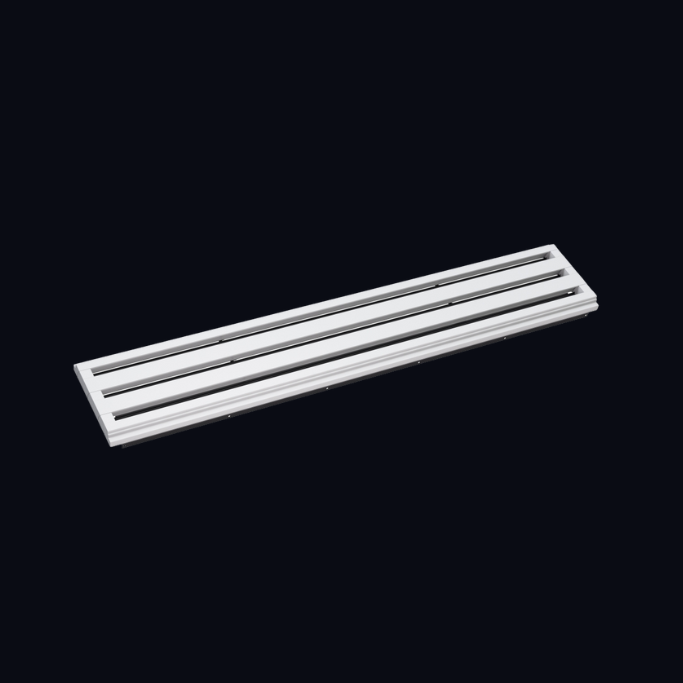
Once the air volume passes roughly 200 m³/h, or the architecture wants a line rather than a point, you move to a plasterable linear slot. LINE diffusers (18 mm slot) and PLINE diffusers (20 mm slot) are the frameless equivalents of a linear grille — plaster-in, paintable, available in 1, 2 and 3 slot versions with 90° corner pieces for continuous runs. They are the usual answer for ducted air conditioning and open-plan supply. If you are choosing between them, PLINE vs LINE is the short version.
4. Wall-mounted frameless valves
Not every terminal belongs overhead. The Side Round Diffuser is a frameless valve designed for wall installation, with spigots from 100 mm up to 250 mm and an adjustable gap height so the discharge velocity can be tuned on site. It suits bulkheads, stud walls and any room where the slab above cannot be touched — the case we make in Not Just Ceilings.
Sizing: which spigot does the room need?
Start from the duty, not the product. Approved Document F sets intermittent extract rates for UK dwellings; convert litres per second to cubic metres per hour by multiplying by 3.6, then pick the smallest valve that carries that volume comfortably at low velocity. Oversizing is cheap insurance against noise; undersizing is a whistle you cannot fix after the plaster is on.
| Room | Part F intermittent extract | m³/h | Typical frameless valve |
|---|---|---|---|
| WC / cloakroom | 6 l/s | 22 | Ø100 round or square |
| Bathroom / en-suite | 15 l/s | 54 | Ø100–125 round or square |
| Utility room | 30 l/s | 108 | Ø125–160 round |
| Kitchen — adjacent to hob | 30 l/s | 108 | Ø125–160 round |
| Kitchen — elsewhere | 60 l/s | 216 | Ø160–200 round |
| Bedroom / living supply (MVHR) | per design | typically 30–90 | Ø100–160 round or square |
| Open-plan supply / ducted air con | per design | 200+ | Linear slot (LINE / PLINE) |
Two refinements worth making. First, run the numbers properly — the free Part F Ventilation Calculator and Duct Sizing Calculator take about two minutes each, and our guide to sizing a diffuser from your design rates walks through a worked example. Second, remember that the valve is the last 100 mm of a system: if the branch is overblowing, trim it upstream with an inline foam damper rather than throttling the valve itself, which is what makes terminals hiss.
How a frameless ventilation valve is installed
This is the part that decides whether the finish is invisible or merely tidy. The sequence matters, and it has to be agreed with the plasterer before boarding — not discovered on the day.
- Duct and plenum first. Fix the branch duct and, where the valve sits in an insulated or acoustically sensitive void, the plenum box. Acoustic Box vs Thermo Box explains which one your situation calls for.
- Cut the opening oversize. The aperture in the plasterboard is the valve's outer diameter plus about 10 mm, so the body is bedded in plaster rather than butted against a board edge.
- Set the valve low. The body sits 0.1–1 mm below the finished ceiling plane. That tiny recess is what lets the skim run over the edge without a ridge.
- Fit the click foam and connect. Clip the foam seal and connect the duct to the spigot — insulated flexible ducting where condensation is a risk, and foil tape on every joint.
- Plaster and sand. Skim across the body and feather the joint. Sanding flush is what removes the last trace of a frame.
- Paint, then drop in the cap. Decorate the ceiling with the centre cap out, then fit it. Our decorator's guide covers masking and sheen matching.
The one mistake to avoid: installing a frameless valve after the ceiling is finished. It cannot be retro-fitted into a skimmed ceiling without cutting back the plaster — so the valve has to be on the first-fix drawing, ordered before boarding and on site before the plasterer. Getting it into the model early is the whole point of coordinating diffusers in BIM.
Gypsum or plastic: why the material matters
Most frameless valves on the UK market are moulded plastic bodies with a plasterable face. Ventmann's are a proprietary gypsum composite, and the difference shows in three places. It takes plaster chemically rather than mechanically, so the joint does not open as the building moves and dries. It accepts emulsion directly, which matters enormously on a dark or colour-drenched ceiling — see Any Colour You Like. And it carries lower embodied carbon than an equivalent aluminium or plastic terminal, which is increasingly a line item rather than a nicety.
It is also the reason the valve does not look like a product. A plastic face under paint still reads as plastic in raking light; a gypsum face under paint reads as ceiling. If you want the longer argument, including where metal still wins, read Frameless vs Metal Grilles: An Honest Cost Comparison.
Where frameless valves earn their keep
- Bathrooms and wet rooms — extract where a plastic valve would stain, corrode and collect limescale. See Steam, Spas and Plaster.
- Kitchens — background extract that does not compete with the lighting plan.
- Bedrooms — MVHR supply at low velocity, which is how you get fresh air without noise or draughts.
- Period properties — modern ventilation in a ceiling with cornice and ornate plasterwork; Frameless in a Period Home covers the detailing.
- Hotels, retail and offices — where the ceiling is the brand, not a services zone. See hotel guest rooms and retail ventilation.
- Passivhaus and low-energy builds — airtight construction makes the terminal detail visible in a way leaky buildings never did. See Passivhaus ventilation.
Specification checklist
- Duty in l/s and m³/h, per room, supply and extract separately.
- Spigot diameter — and confirm it matches the branch duct, not the main.
- Shape: round, square, linear or wall-mounted.
- Ceiling build-up and void depth — this decides whether a plenum box is needed.
- Acoustic target. Ventmann quotes airflow at 17 dB(A); most installers work to 25 dB.
- Who is cutting the aperture, and when the valve lands on site relative to the plasterer.
- Finish: emulsion colour and sheen, so the cap is decorated with the ceiling.
Who this guide is for: architects and interior designers specifying ceilings, M&E consultants and building services designers, MVHR and air conditioning installers, main contractors and self-builders — anyone who has to put a ventilation terminal in a room where it must not be seen.
Quick answers
What is a frameless ventilation valve?
It is an air valve whose body is plastered into the ceiling or wall so that no rim or flange is visible. The face finishes flush with the surrounding plaster and is painted with the ceiling, leaving only a shadow line. It works as both a supply valve and an extract valve.
Can a frameless ventilation valve be painted?
Yes — and it is designed to be. A gypsum-composite valve takes standard emulsion directly, so it can be finished in the ceiling colour, including dark and colour-drenched schemes. Decorate with the centre cap removed, then refit it.
What sizes do frameless ventilation valves come in?
Round frameless valves are offered with 100, 125, 160 and 200 mm spigots; square valves with 100 and 125 mm; and the wall-mounted Side Round up to 250 mm. For higher volumes, a plasterable linear slot replaces the round valve.
How much air can a frameless valve handle?
A single-slot Ø160 round valve carries up to 200 m³/h and a Ø200 up to 300 m³/h at the quoted 17 dB(A). As a rule of thumb, a Ø100 covers a WC or small bathroom, Ø125 a bathroom or utility, and Ø160–200 a kitchen or open-plan supply.
Can frameless valves be retrofitted into an existing ceiling?
Only by cutting back the plaster. The valve body has to be in place before skimming, so on a refurbishment it belongs in the first-fix programme. In a finished room, a surface-mounted valve or a framed grille is the realistic alternative.
Are frameless ventilation valves suitable for MVHR?
Yes — they are arguably the natural terminal for it. MVHR puts supply and extract valves in every habitable room, so the terminal detail is repeated dozens of times across a house; a frameless valve is what stops that repetition from reading as plant. Size each one from the commissioning schedule, not from the duct diameter.
What is the difference between a valve, a grille and a diffuser?
A valve controls a single duct's air volume at a point, a grille covers an opening, and a diffuser shapes how the air enters the room. Frameless gypsum terminals blur the line because they do all three — the longer answer is in grille vs vent vs diffuser.
Not sure which valve the room needs?
Send us your floor plan and we will run the airflow calculations, size every valve, plenum and damper, and schedule them room by room — free, with next-day UK delivery on stock items.
Get Free Airflow CalculationsOpen the Product Selector
Call 01283 240025 · Email sales@ventmann.co.uk