


Swirl Diffusers vs Frameless Circular Diffusers: Which Ceiling Diffuser Does Your Project Need?

Swirl diffusers are the workhorse of large commercial ceilings: a round or square face with radial blades that spin the supply air into a fast-mixing, high-induction pattern. They are excellent at what they do. They are also frequently specified in rooms far too small for them, because "swirl" has become shorthand for "a diffuser that does not drop air on people". This article explains what a swirl diffuser is, where it belongs, and when a frameless circular Coanda diffuser is the better answer.
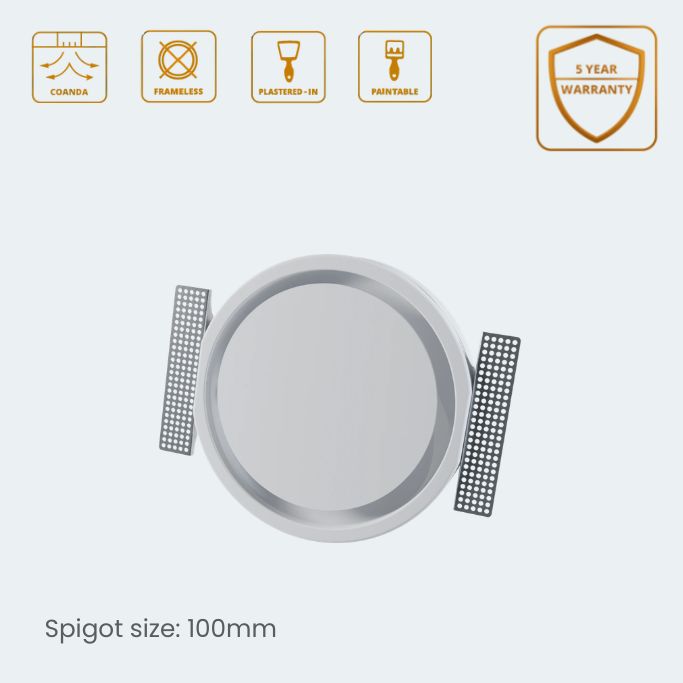
A frameless circular Coanda diffuser: the small-room answer to the same comfort problem a swirl diffuser solves in large ones.
What a swirl diffuser is
A swirl diffuser has a face of fixed or adjustable radial blades — a wheel of vanes — that impart rotation to the air leaving it. The rotating jet spreads horizontally across the ceiling and entrains a great deal of room air very quickly, so the supply air reaches room temperature within a short distance of the terminal. That high induction is why swirls can handle large temperature differences between supply and room air and large flow rates per terminal without draughts, and why they dominate offices, retail halls, airports and anywhere else with a 600 × 600 ceiling grid and a lot of air to move. Faces are typically 300 to 600 mm, in steel or aluminium, visible.
What a frameless circular diffuser is
The Performance Circle is a much smaller terminal — 100 to 200 mm spigots — made of gypsum so it plasters into the ceiling and disappears. Its curved internal geometry turns the supply air outwards so it attaches to the ceiling by the Coanda effect and spreads radially, mixing as it goes. The comfort outcome is similar to a swirl: no jet on the occupant, air tempered before it descends. The scale, the appearance and the duty are different.
Performance Circle Diffusers
The circular frameless terminal. Curved internal geometry turns the supply air outwards along the surface (the Coanda effect), giving wide dispersal and almost no perceptible airflow directly below. Four spigot sizes cover everything from an MVHR bedroom branch to a cooled open-plan space.
- Shape Circular, frameless, plaster-in
- Slots 1 or 2
- Spigot sizes 100, 125, 160 and 200 mm
- Material Gypsum, supplied white, fully paintable
- Duty Supply or extract, heating and cooling
- Price From £86.65 excl. VAT
Side by side
| Swirl diffuser | Frameless circular Coanda diffuser | |
|---|---|---|
| Air pattern | Rotating, horizontal, very high induction | Radial, attached to the ceiling, high induction at domestic scale |
| Face / size | 300–600 mm visible metal face | 100–200 mm spigot; shadow gap only on view |
| Flow per terminal | High — hundreds of l/s | Room-scale — one terminal per room |
| Ceiling | Suspended grid or plasterboard with a frame | Plasterboard, plastered in and painted |
| Best for | Open-plan offices, retail, halls, high ceilings | Bedrooms, hotel rooms, offices with fixed desks, homes, treatment rooms |
| Appearance | A visible commercial diffuser | Invisible once painted |
| Cost | Higher per unit, fewer units | Lower per unit, one per room |
When a swirl is the right choice
- Large volumes of air per terminal — open-plan floors, retail halls, lecture theatres.
- High ceilings where throw and mixing distance are available.
- Big supply-to-room temperature differences, where high induction is needed to temper the air quickly.
- Suspended-ceiling grids where a 600 × 600 face is already the module.
When a frameless circular diffuser is the right choice
- Rooms with one terminal — bedrooms, hotel rooms, consulting rooms, cellular offices, bathrooms.
- Normal domestic ceiling heights, where a swirl's throw would hit the walls and come back.
- Plasterboard ceilings that are part of the design.
- MVHR and domestic cooling duties on 100–200 mm branches.
- Anywhere the diffuser should not be seen.
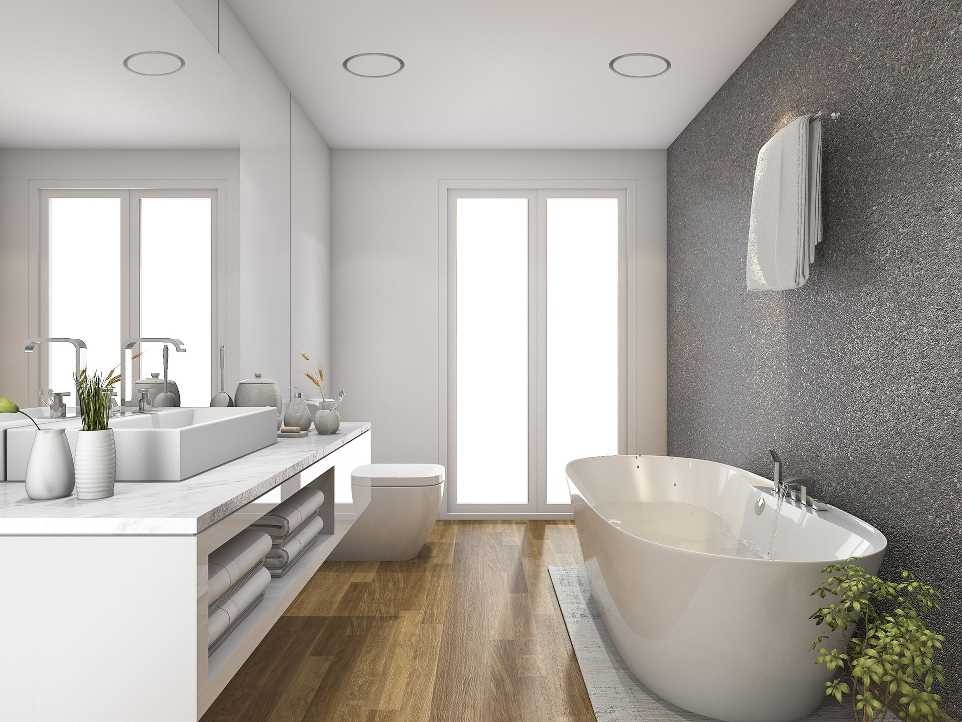
In a bathroom or bedroom, a swirl diffuser is the wrong scale. A frameless circle is the right one.
The mistake to avoid
Specifying a swirl because the room is cooled. Cooling does need a pattern that keeps the cold air off the occupant — but in a 20 m² room a 300 mm swirl is oversized, visible and over-specified. A 160 or 200 mm frameless Coanda diffuser, or a two-slot Performance Line, does the comfort job at the right scale and leaves the ceiling plain.
Mixed projects: use both
A hotel is the usual example: swirl diffusers in the lobby, restaurant and ballroom where the volumes are large and the ceiling is a grid; frameless circles in every guest room, where one terminal per room, silence and a clean ceiling matter. The hotel guest room article covers the room side.
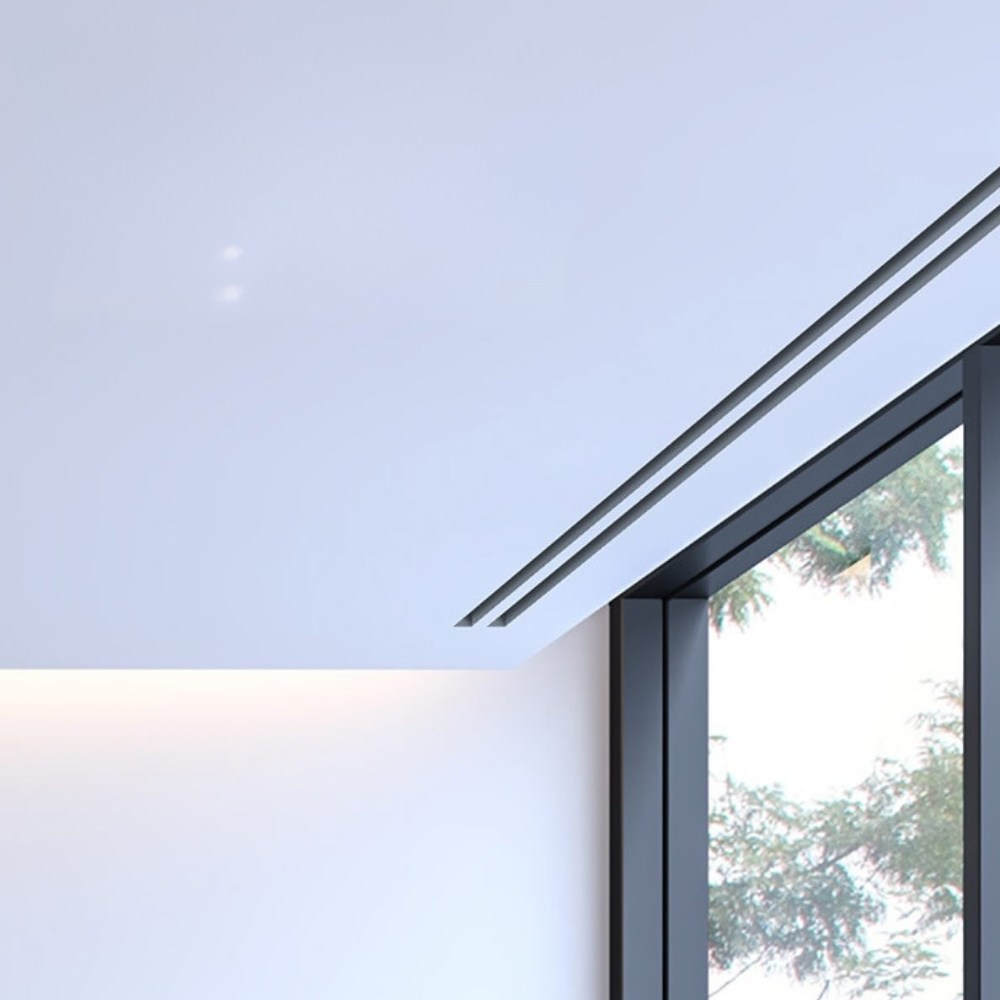
Performance Line Diffusers
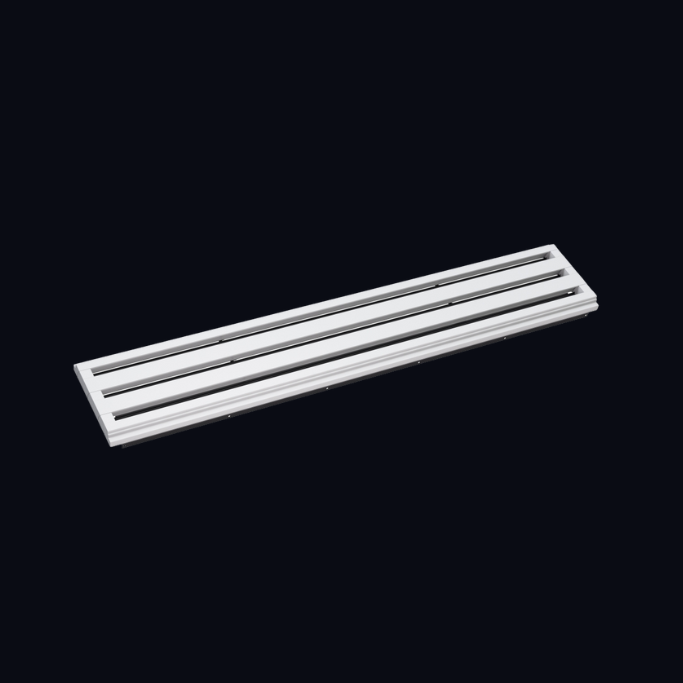
The higher-performance linear slot. A wider Coanda-profiled slot with an adjustable deflector, so the air attaches to the ceiling and spreads across it instead of dropping into the room — the slot to specify where the duty per metre is higher or the room is occupied directly underneath.
- Slots 1, 2 or 3
- Lengths 625, 1000 and 1250 mm
- Air pattern Coanda — attached to the ceiling or wall
- Deflector Included; perforated option available
- Material Gypsum, supplied white, fully paintable
- Price From £148.11 excl. VAT
Frequently asked questions
What is a swirl diffuser?
A ceiling diffuser with radial blades that spin the supply air into a rotating horizontal jet. The rotation mixes room air into the supply quickly (high induction), which allows large flow rates and temperature differences without draughts.
Where are swirl diffusers used?
Large commercial spaces — open-plan offices, retail, airports, halls — usually in 600 × 600 ceiling grids with high air volumes per terminal.
Is a swirl diffuser suitable for a bedroom or small room?
Rarely. It is oversized for the duty and visible. A frameless Coanda circular diffuser gives the same draught-free result at room scale and disappears into the ceiling.
What is the difference between a swirl diffuser and a Coanda diffuser?
Both keep air off the occupant by spreading it along the ceiling. A swirl does it by rotation at large scale with a visible metal face; a frameless Coanda circle does it with a curved profile at 100–200 mm, plastered into the ceiling.
Can swirl and frameless diffusers be used on the same project?
Yes — swirls in large public spaces and frameless circles or slots in cellular rooms is a common and sensible split.
Are frameless circular diffusers high-induction?
At their scale, yes: the Coanda pattern entrains room air along the ceiling so the supply has tempered before it descends, which is the same comfort mechanism a swirl relies on.
Not sure which terminal you need?
Send us your floor plan and we will run the airflow calculations, size every diffuser, plenum and damper, and get the kit to you with next-day UK delivery — free.
Call 01283 240025 · Email sales@ventmann.co.uk
Shop Performance CircleGet Free Airflow Calculations