


Ceiling Diffusers: The Complete UK Guide to Types, Frameless Options and How to Choose

A ceiling diffuser is the part of a ventilation or air-conditioning system that people actually see, and for most of the last fifty years it has been an aluminium square with louvres screwed to the plasterboard. That is no longer the only option. This guide explains what a ceiling diffuser does, the main types sold in the UK, how framed and frameless designs differ, and how to choose the right one for a home, hotel or office.
Whatever the system behind it — MVHR, ducted air conditioning, warm-air heating or a commercial AHU — the diffuser decides three things in the room: how far the air travels, whether anyone feels it, and how much noise arrives with it. Choosing one is a comfort decision and an architectural decision at the same time.
A frameless ceiling diffuser after skimming and painting. The ceiling carries on; only the slot is visible.
What a ceiling diffuser does
A diffuser is the terminal at the end of a duct. Its job is to take air arriving at duct velocity and spread it into the room at a speed and pattern that nobody notices — mixing supply air with room air before it reaches anyone, and doing it quietly. A grille simply covers an opening; a diffuser shapes the airflow. The same unit can usually be used for supply (air into the room) or extract (air out), and for heating as well as cooling.
Two numbers describe how it performs: the throw (how far the air travels before it slows to a drift) and the noise level at the design flow rate. Both depend on the free area of the face and the shape of the air path through it, which is why diffusers of the same nominal size can behave very differently.
The main types of ceiling diffuser
| Type | Air pattern | Where it is used | Typical sizes |
|---|---|---|---|
| Linear slot diffuser | Long, narrow jet along or across the slot; Coanda versions spread along the ceiling | Continuous architectural lines, perimeter runs, offices, living rooms | 1–3 slots, 625–1250 mm lengths, joined end to end |
| Circular (round) diffuser | Radial, 360° around the face | Bedrooms, bathrooms, hotel rooms, MVHR branches | 100, 125, 160 and 200 mm spigots |
| Square diffuser | Four-way or adjustable | Ceilings set out on a grid, offices, utility rooms | 100 and 125 mm spigots (frameless); 600 × 600 tiles (metal) |
| Swirl diffuser | Rotating, high-induction jet | Commercial spaces with high air volumes and tall ceilings | 300–600 mm faces, usually metal |
| Ceiling grille / louvre | Straight through, little diffusion | Extract points, transfer air, low-cost installations | Any; often 150–300 mm |
Framed metal or frameless plaster-in?
The second decision is how the diffuser meets the ceiling. A conventional metal diffuser has a flange that sits on the plasterboard and a visible frame around the face. A frameless plaster-in diffuser is made of gypsum, bonds into the plasterboard with ordinary jointing compound, and is skimmed and painted with the ceiling. Once decorated, the only thing on view is the slot or the shadow gap.
- Appearance. No frame, no flange, no screw heads. The diffuser reads as a detail in the ceiling rather than an object fixed to it.
- Finish. Gypsum takes emulsion or spray paint, so a dark or coloured ceiling gets a matching diffuser instead of a white rectangle.
- Thermal behaviour. No metal flange means no cold bridge and no condensation line at the ceiling.
- Noise. Profiles shaped to let the air turn gradually generate less turbulence than a sharp-edged louvre at the same flow rate.
- Trade. A plaster-in terminal is finished by the plasterer and decorator, not the ventilation engineer — which is what makes it practical on real sites.
Terminology. Suppliers use ceiling diffuser, ceiling vent, ceiling grille, air valve and register for overlapping things. In the UK, a register usually means a grille with a built-in damper; an air valve is the small round plastic or metal terminal common on MVHR systems; a diffuser is anything designed to shape and spread the airflow.
The frameless range, by room shape
Ventmann makes one family of gypsum terminals so that a whole project can hold a single language — linear, circular or square — with the same plaster-in detail and the same paintable finish throughout.
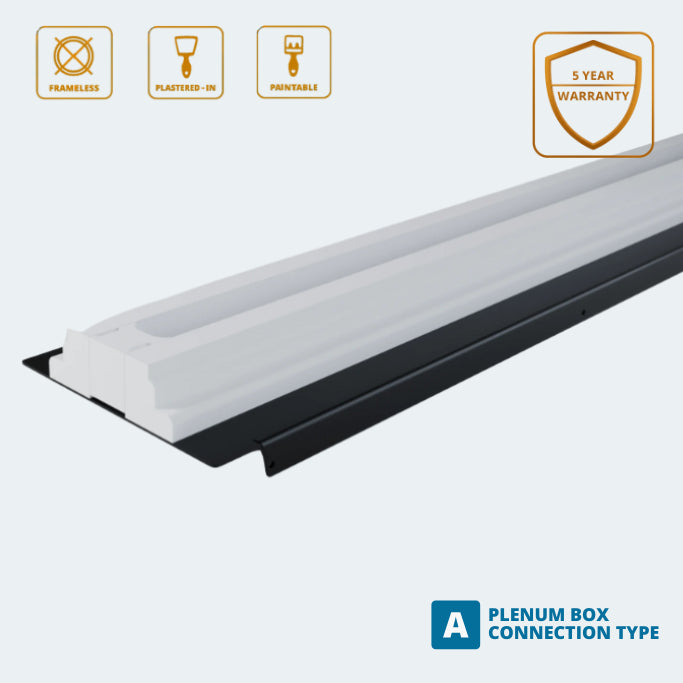
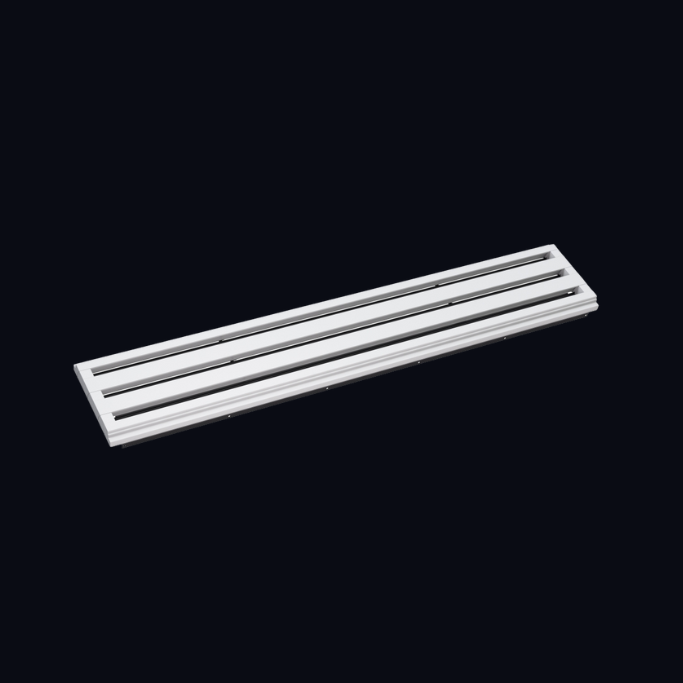
Line Diffusers
The standard Ventmann linear slot diffuser: a gypsum body with an 18 mm slot that plasters into the ceiling or wall and joins end to end for continuous runs. Supplied white and painted with the surface, so the only thing left on view is the slot.
- Slots 1, 2 or 3
- Lengths 625, 1000 and 1250 mm — joins end to end
- Slot width 18 mm
- Material Gypsum, supplied white, fully paintable
- Mounting Plasterboard ceiling or wall, plaster-in
- Duty Supply or extract
- Price From £125 excl. VAT
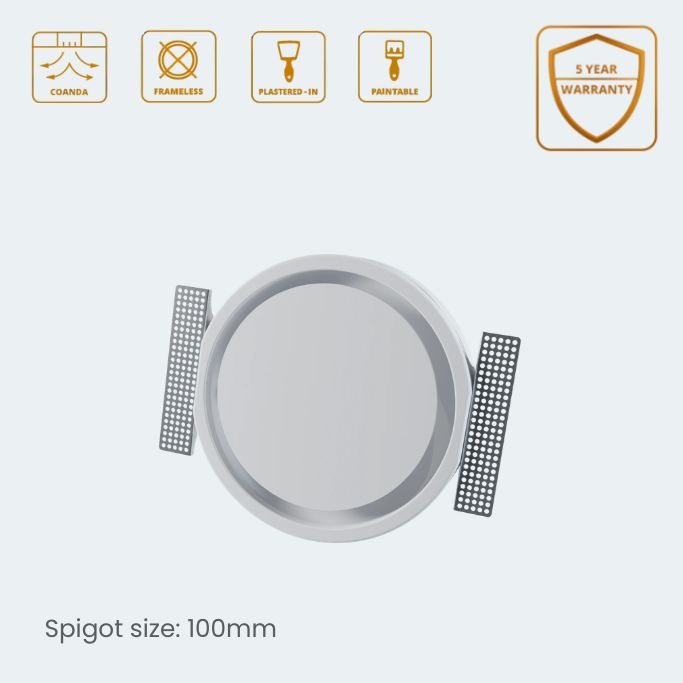
Performance Circle Diffusers
The circular frameless terminal. Curved internal geometry turns the supply air outwards along the surface (the Coanda effect), giving wide dispersal and almost no perceptible airflow directly below. Four spigot sizes cover everything from an MVHR bedroom branch to a cooled open-plan space.
- Shape Circular, frameless, plaster-in
- Slots 1 or 2
- Spigot sizes 100, 125, 160 and 200 mm
- Material Gypsum, supplied white, fully paintable
- Duty Supply or extract, heating and cooling
- Price From £86.65 excl. VAT
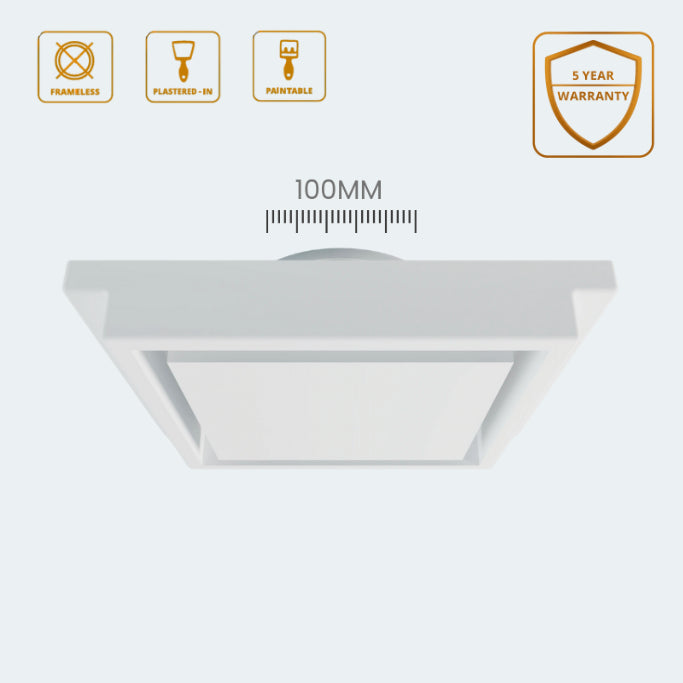
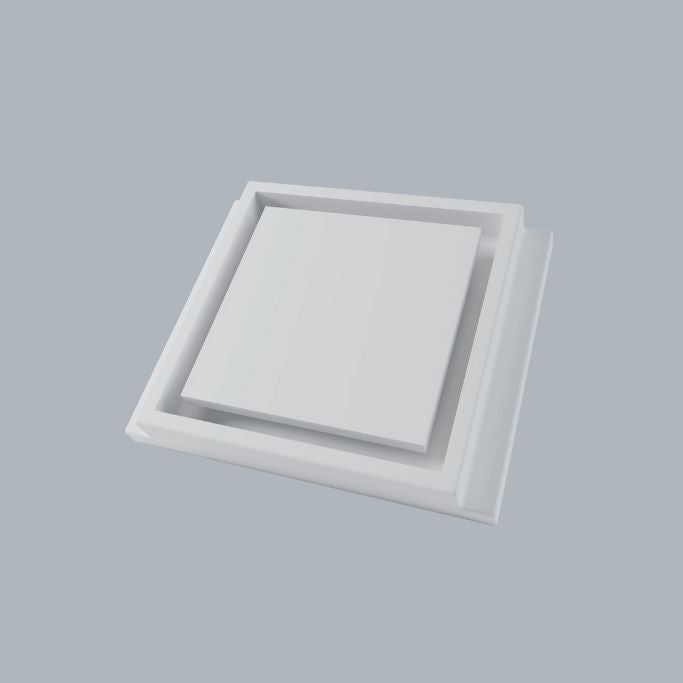
Square Diffuser
The same plaster-in gypsum construction in a square face, for ceilings set out on a rectilinear grid. Adjustable blocks held on industrial-strength magnets let the installer tune the air pattern after the ceiling is painted.
- Spigot sizes 100 and 125 mm
- Weight 2.40 kg
- Mounting Ceiling (most common) or wall
- Cut-out Outer diameter + 1 cm, circular opening
- Material Gypsum, supplied white, fully paintable
- Price £67.74 excl. VAT
For walls, the Side Round and Side Square diffusers use the same construction; for decorative return-air openings there are the ART frameless grilles.
How to choose a ceiling diffuser
- Start with the flow rate, not the room size. The duty (litres per second) for each room comes from the ventilation design. The diffuser must deliver it at a face velocity low enough to stay quiet.
- Decide the air pattern. Rooms where people sit or sleep directly underneath want a Coanda (ceiling-hugging) pattern. Corridors and tall spaces can take a downward throw.
- Match the spigot to the duct. 100 and 125 mm for MVHR branches; 160 and 200 mm where one terminal carries more air, typically on cooling.
- Decide the look. A continuous slot, a single circle or a square — and whether it should disappear (frameless, painted) or be a visible element.
- Plan what sits behind it. A plenum box for slots, a damper in the branch for balancing, acoustic ducting on the last run into quiet rooms.
- Check the ceiling build-up. Plaster-in diffusers need a plasterboard ceiling or wall and a void deep enough for the plenum; shallow voids use a side-entry plenum.

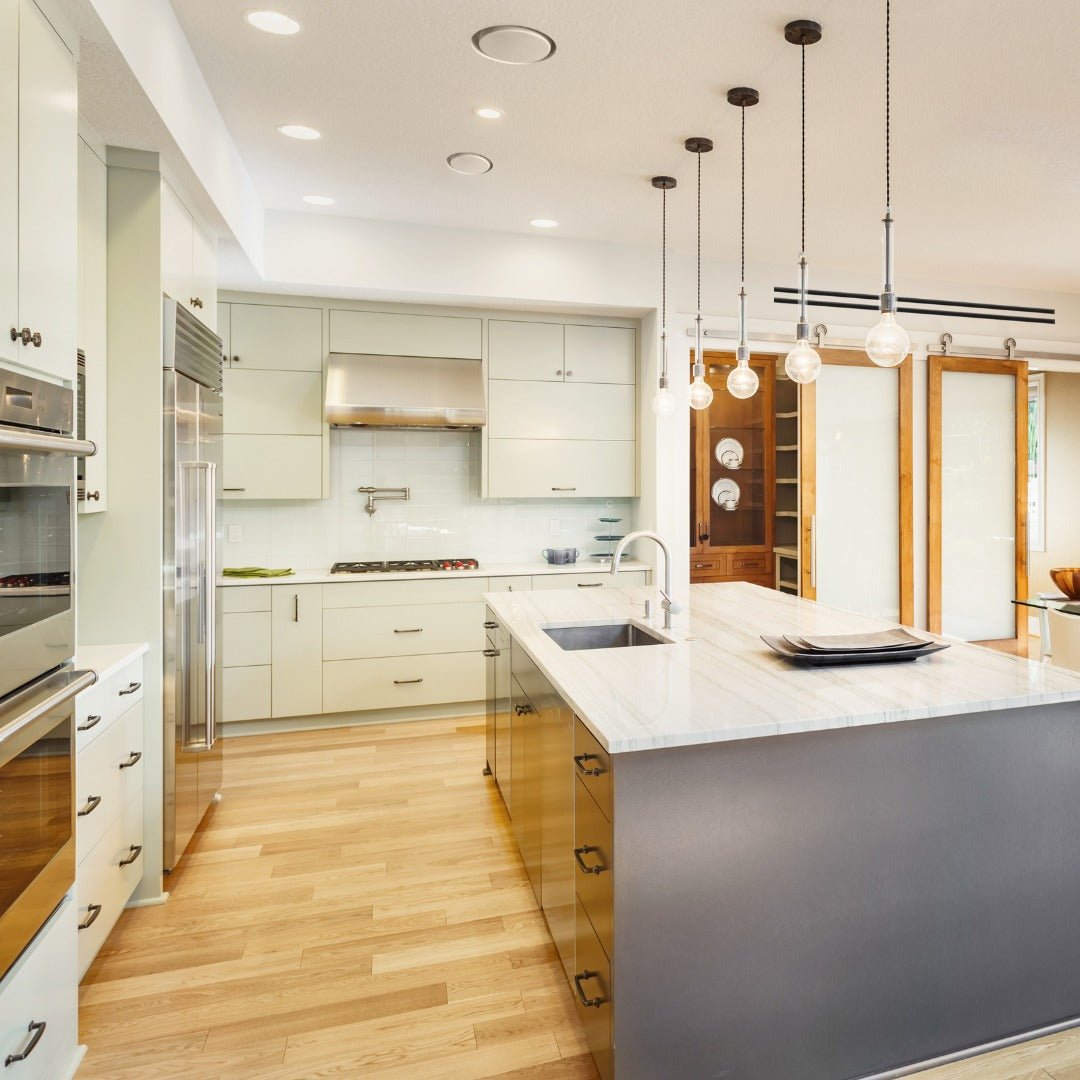
Linear, circular and square terminals share the same plaster-in detail, so a project can mix shapes without mixing finishes.
Commercial and residential: the same product, different duties
The physics do not change between a bedroom and a boardroom, but the duty does. Residential MVHR systems move modest volumes through 100 and 125 mm branches, so small circular and single-slot terminals dominate. Offices, retail and hospitality on ducted air conditioning need more air per terminal, which is where two-slot circles, 160–200 mm spigots and multi-slot linear runs come in. Ventmann supplies both markets from the same range; the commercial and domestic pages set out typical specifications for each.
What a ceiling diffuser costs
Frameless gypsum terminals start at £67.74 excl. VAT for the Square Diffuser, £86.65 for the Performance Circle and £125 for a Line slot diffuser, with a 5-year warranty and next-day UK delivery on orders placed before 11:00. Plenum boxes, dampers and ducting are priced separately; a complete bedroom terminal with plenum typically lands between £150 and £250 ex VAT. Trade accounts see discounted pricing after login.
Frequently asked questions
What does a ceiling diffuser do?
It spreads the air arriving from a duct into the room at a comfortable speed and in a controlled pattern, mixing supply air with room air so that nobody feels a jet, and doing so quietly. Extract diffusers do the reverse.
What is the difference between a ceiling vent and a ceiling diffuser?
A vent or grille is an opening with a cover; a diffuser is engineered to shape the airflow. Many products sold as ceiling vents are diffusers, and vice versa — judge by the air pattern and noise data rather than the name.
What are ceiling vent covers called?
Depending on the trade: grilles, registers (with a damper), air valves (small round MVHR terminals), louvres, or diffusers. Frameless plaster-in versions are often called gypsum diffusers or plaster-in vents.
Which ceiling diffuser is best for a bedroom?
One with a Coanda air pattern, sized for the room's flow rate at a low face velocity, fed through acoustic ducting. The frameless Performance Circle in 100 or 125 mm is the usual choice on MVHR.
Can a ceiling diffuser be painted?
A gypsum plaster-in diffuser is designed to be: it is supplied white and takes emulsion or spray paint after installation. Metal diffusers can be powder-coated to order but cannot be painted on site to the same standard.
How much does a ceiling diffuser cost in the UK?
Metal louvre grilles start at a few pounds; frameless gypsum diffusers start at around £68 excl. VAT for a square terminal and £87 for a round one, with linear slots from £125 per length.
Not sure which terminal you need?
Send us your floor plan and we will run the airflow calculations, size every diffuser, plenum and damper, and get the kit to you with next-day UK delivery — free.
Call 01283 240025 · Email sales@ventmann.co.uk
Shop ceiling diffusersGet Free Airflow Calculations