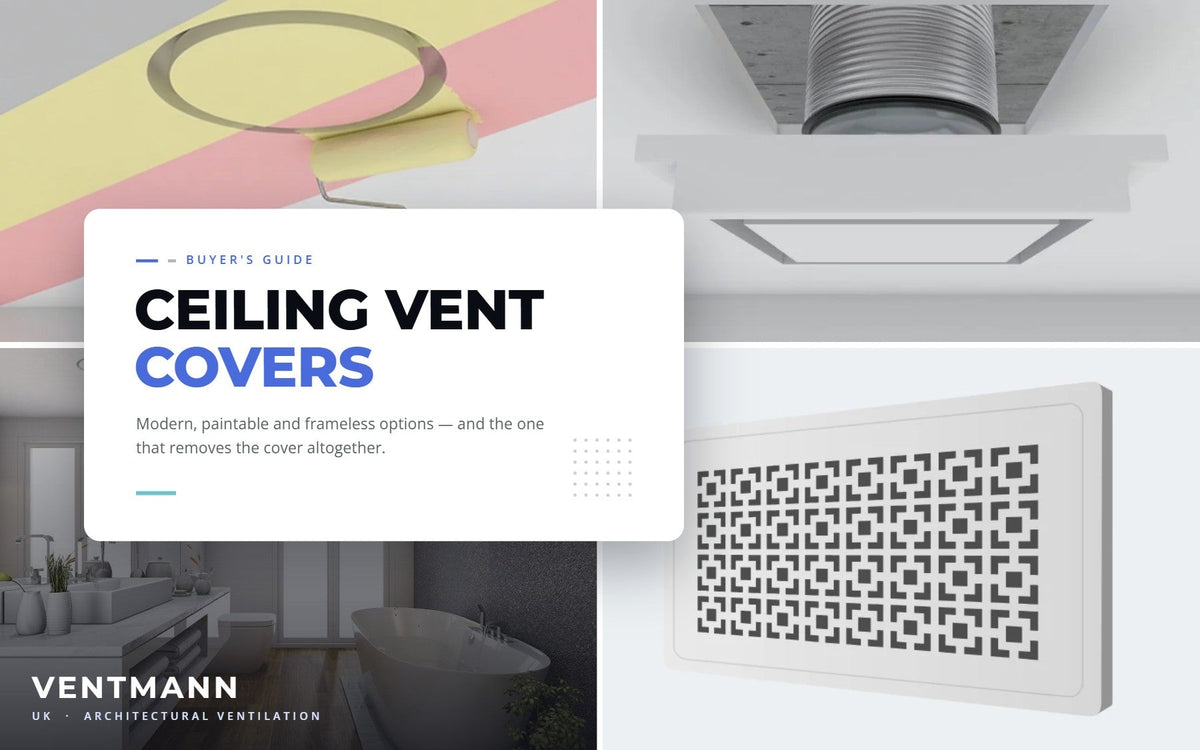



Plasterboard Vents: How to Fit Air Vents into Plasterboard Ceilings and Walls (Plaster-In Options)
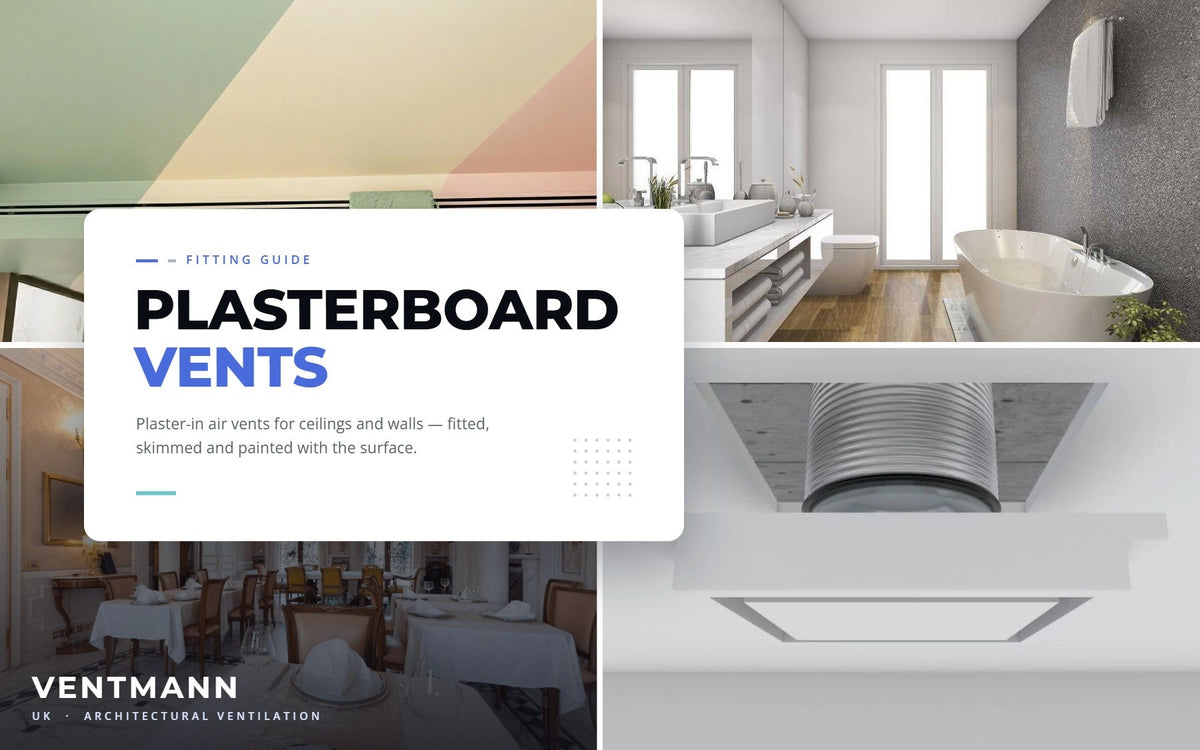
Most air vents sold for plasterboard are plastic louvres: you cut a hole, push the vent in and the flange hides the edge. They work, and they look like exactly what they are. A plasterboard vent can also be the opposite — a gypsum terminal that is skimmed into the board and painted, so that the ceiling or wall stays one unbroken surface. This guide covers both routes, how a plaster-in vent is fitted, and what to specify for MVHR, air conditioning and simple extract.
The distinction matters more than it sounds. A surface-mounted vent is finished by whoever fits the ventilation. A plaster-in vent is finished by the plasterer and decorator, with the materials already on site, which is why it is the route architects take when the ceiling is part of the design.
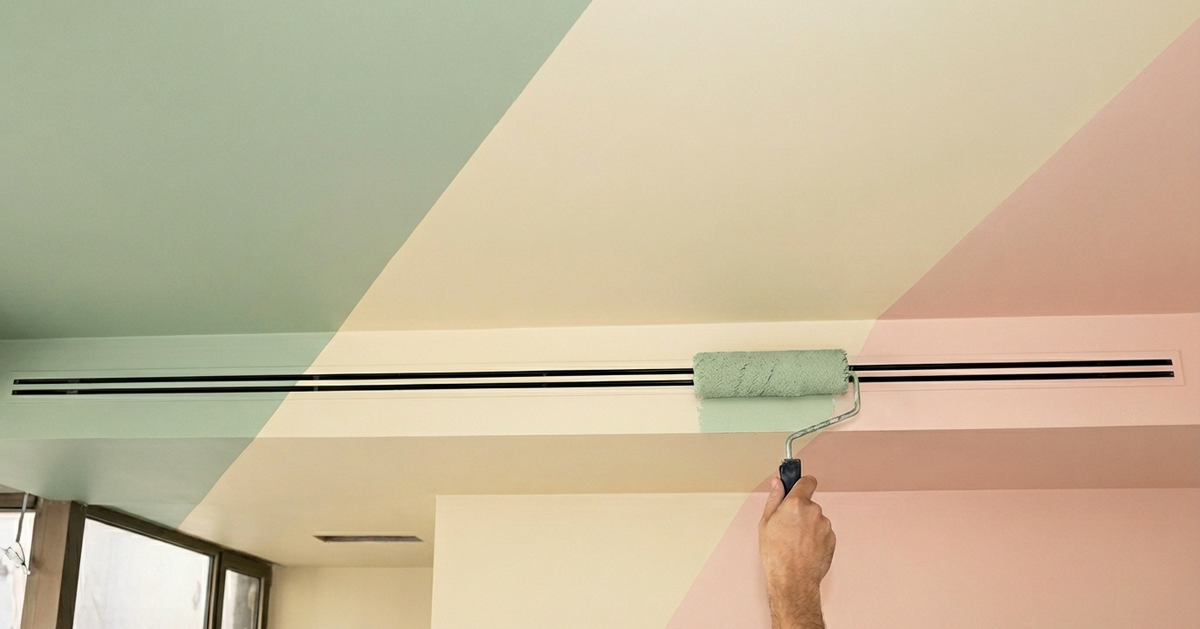
Plaster-in vents after skimming. From here they are painted with the ceiling and effectively disappear.
The three kinds of plasterboard vent
| Type | How it meets the board | Finish | Best for |
|---|---|---|---|
| Plastic louvre vent | Pushed or screwed into a cut-out; flange covers the edge | White plastic, visible frame | Budget extract, utility rooms, airbrick-style transfer vents |
| Metal grille or valve | Spigot through the board, flange on the surface | Powder-coated, visible frame | MVHR air valves, commercial grilles, suspended ceilings |
| Plaster-in gypsum diffuser | Bonded into the board with jointing compound, skimmed flush | Painted with the surface, no frame | Any room where the ceiling or wall is meant to read as one plane |
How a plaster-in vent is fitted into plasterboard
The sequence is the same whether the terminal is a circle, a square or a linear slot, and it is a plasterer's job rather than a ventilation engineer's.
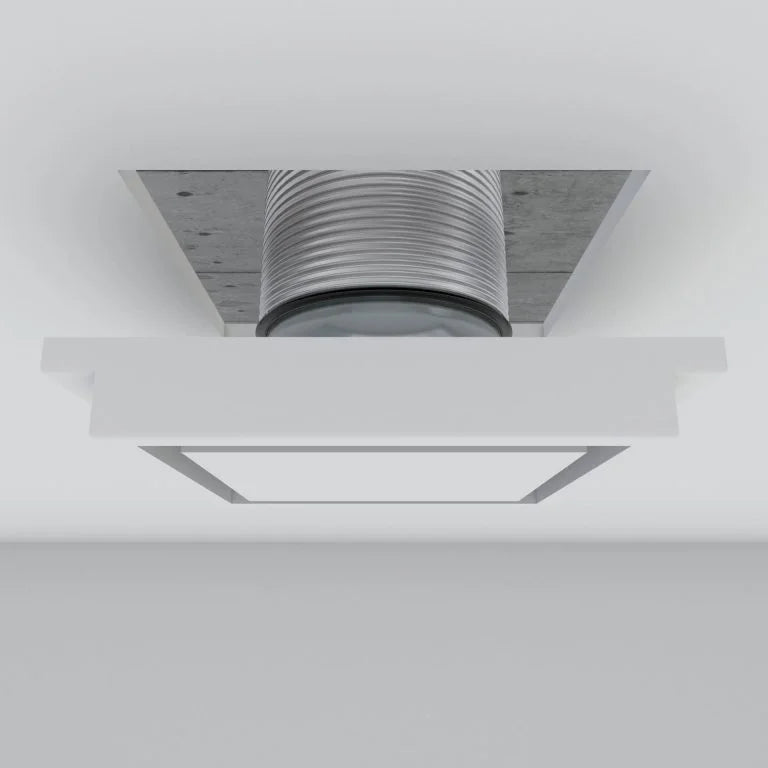
- Position the duct first. Bring the flexible or rigid duct to the terminal position in the void before the board goes up, with room for the plenum or spigot.
- Cut the opening to the body, not the duct. For round terminals the cut-out is the body diameter plus about 10 mm; for slots, the plenum sets the opening. Cutting to the duct diameter leaves the body with nothing to bear on.
- Fix the body to the board. Circular and square terminals fix through side brackets; linear slots hang from their plenum, with the board lifted up to meet the diffuser face.
- Skim the joint. Fill and feather the gypsum flange into the plasterboard with ordinary jointing compound, then sand flush.
- Paint with the surface. Emulsion or spray paint, applied after the ceiling is finished. The vent takes whatever the ceiling takes.
Can you plaster over an air vent? Not a conventional one — covering a plastic or metal vent with plaster blocks it and cracks almost immediately, because plaster does not bond to the flange. A plaster-in gypsum vent is designed for exactly this: the flange is gypsum, the compound bonds to it, and the opening stays open. Only the face is painted, never filled.
Plasterboard ceilings: which terminal where
For a plasterboard ceiling the choice is mostly about air pattern and duty. Round terminals suit single points in bedrooms and bathrooms; slots suit continuous lines and higher duties; squares suit gridded layouts.

Performance Circle Diffusers
The circular frameless terminal. Curved internal geometry turns the supply air outwards along the surface (the Coanda effect), giving wide dispersal and almost no perceptible airflow directly below. Four spigot sizes cover everything from an MVHR bedroom branch to a cooled open-plan space.
- Shape Circular, frameless, plaster-in
- Slots 1 or 2
- Spigot sizes 100, 125, 160 and 200 mm
- Material Gypsum, supplied white, fully paintable
- Duty Supply or extract, heating and cooling
- Price From £86.65 excl. VAT
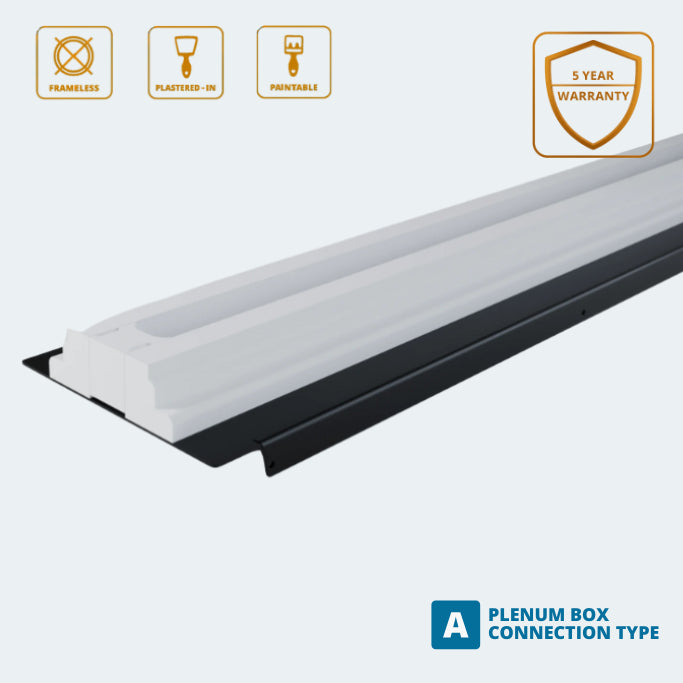
Line Diffusers
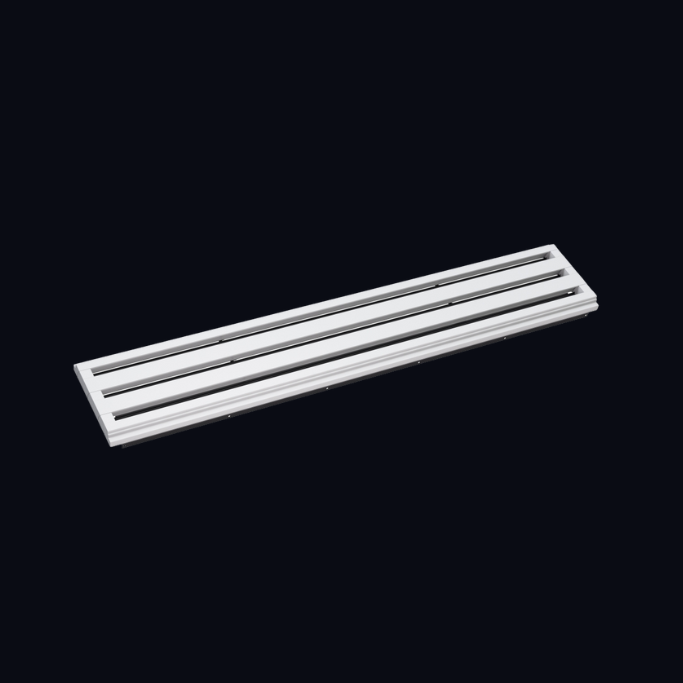
The standard Ventmann linear slot diffuser: a gypsum body with an 18 mm slot that plasters into the ceiling or wall and joins end to end for continuous runs. Supplied white and painted with the surface, so the only thing left on view is the slot.
- Slots 1, 2 or 3
- Lengths 625, 1000 and 1250 mm — joins end to end
- Slot width 18 mm
- Material Gypsum, supplied white, fully paintable
- Mounting Plasterboard ceiling or wall, plaster-in
- Duty Supply or extract
- Price From £125 excl. VAT
Plasterboard walls: the side-entry option
Where there is no ceiling void — a loft conversion with sloping ceilings, a solid-floor apartment, a retrofit MVHR run inside a boxed service riser — the vent goes in the wall instead. The frameless wall terminals plaster into the board in exactly the same way and throw the air along the wall surface so it does not land on the occupant.
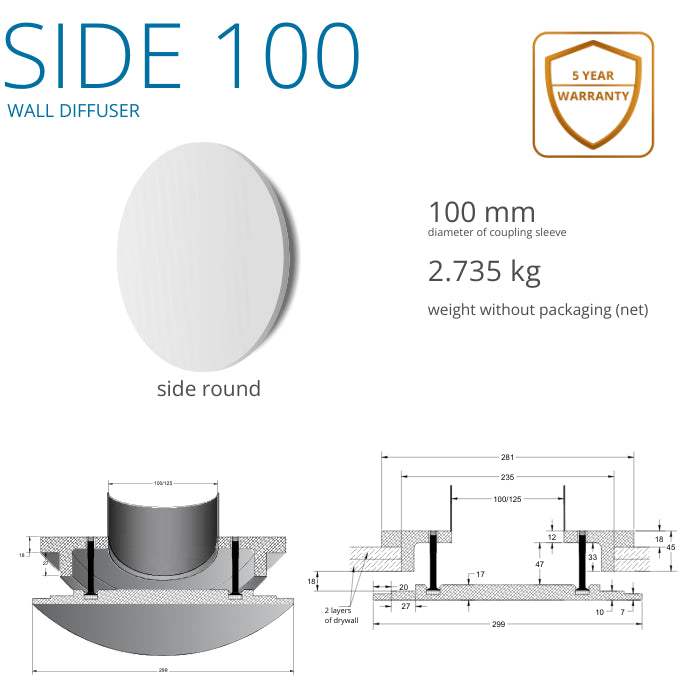
Side Round Diffuser
For rooms with no ceiling void. A frameless round terminal that plasters into a wall (or ceiling) and throws air along the surface, with an adjustable gap height to change the air speed. Five spigot sizes up to 250 mm.
- Spigot sizes 100, 125, 160, 200 and 250 mm
- Adjustment Gap height sets the airflow speed
- Mounting Wall or ceiling, plaster-in
- Material Gypsum, supplied white, fully paintable
- Price From £122.37 excl. VAT
Linear slots also work in a wall, fed from a side-entry Thermo Box plenum where the duct arrives horizontally. The wall-mounted diffusers article covers the layout rules.
Plaster vent covers and grilles for extract
Extract points — bathrooms, en-suites, utility rooms, kitchens on MVHR — need a terminal just as much as supply points, and they are the ones most often left as a plastic valve because "nobody looks at them". A gypsum terminal used for extract is the same product; it simply pulls air instead of pushing it. For larger return-air openings and decorative covers, the ART frameless grilles put a laser-cut metal pattern inside a gypsum surround, held on magnets.
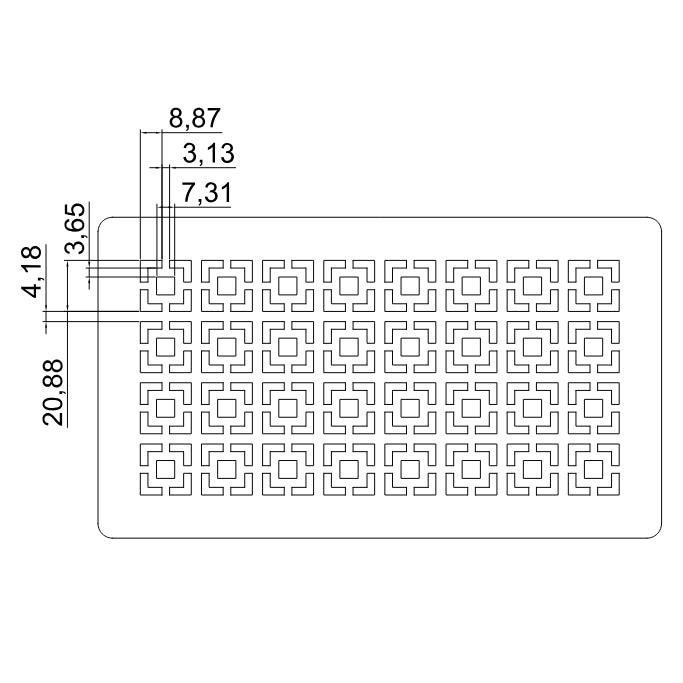
ART Frameless Grilles
A frameless gypsum surround with a precision laser-cut metal pattern inside, held on industrial-grade magnets so there are no visible fixings. Three patterns (ART 1, 3 and 6) in three sizes, for return-air openings, fireplaces and inspection hatches.
- Patterns ART 1, ART 3, ART 6
- Sizes 200 × 100, 300 × 200, 400 × 300 mm
- Fixing Magnets — no locks or handles
- Colour White; custom colours on request
- Lead time 4–6 weeks
- Price From £193.10 excl. VAT
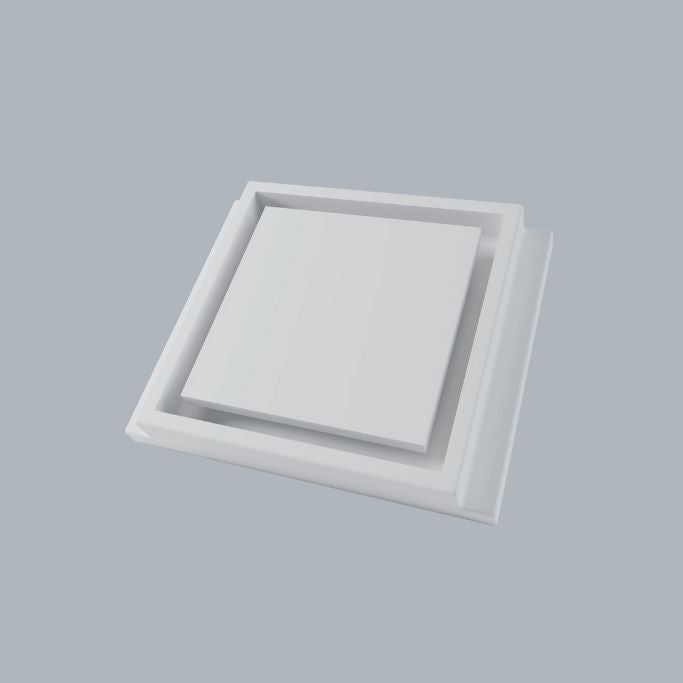
A square plaster-in vent in a painted ceiling. Supply or extract, the finish is the same.
What to order
- The terminal in the right shape and spigot size for each room.
- A plenum box for every linear slot (top entry Acoustic Box or side entry Thermo Box) and, for ART grilles, the ART plenum.
- Spigots, reducers and couplers to connect the duct — see fittings.
- Ducting: acoustic for the last run into quiet rooms, insulated wherever a run crosses a cold void.
- A sample if the client needs to see the finish before approving the specification.
Frequently asked questions
What is a plasterboard vent?
Any air terminal fitted into a plasterboard ceiling or wall. The cheapest are push-in plastic louvres with a visible flange; plaster-in gypsum vents are skimmed into the board and painted so that no frame is visible.
What is a plaster vent?
A vent made of gypsum (the same material as plasterboard) that is bonded into the surface with jointing compound and finished by the plasterer. Also sold as a plaster-in vent, frameless vent or gypsum diffuser.
Can you plaster over air vents?
Not an ordinary plastic or metal one — the plaster cracks and the vent is blocked. A plaster-in gypsum vent is designed to be skimmed around its flange while the opening stays clear.
Do plaster-in vents work with MVHR?
Yes. They connect to 100 and 125 mm MVHR branches (larger sizes for higher duties) and can be used for both supply and extract. They replace the plastic valves normally supplied with the unit.
Can a plasterboard air vent go in a ceiling and a wall?
Yes. Circular, square and linear frameless terminals all fit either; wall installations usually use a side-entry plenum for slots.
Do I need a plasterer to fit one?
The ventilation installer positions the duct and body; the plasterer skims the joint and the decorator paints it. On a new build those trades are already on site, which is what makes the detail economical.
Not sure which terminal you need?
Send us your floor plan and we will run the airflow calculations, size every diffuser, plenum and damper, and get the kit to you with next-day UK delivery — free.
Call 01283 240025 · Email sales@ventmann.co.uk
Shop plaster-in ventsGet Free Airflow Calculations