


Frameless vs Metal Grilles: An Honest Cost Comparison
We sell frameless gypsum grilles, so take this with the appropriate pinch of salt — but there is no point pretending a frameless grille is cheaper than a metal one, or that it is the right answer everywhere. This is the honest comparison, including the applications where you should specify a metal grille and we would tell you so.
The honest summary
A frameless gypsum grille costs roughly three to five times a standard metal grille once you include the plenum, and adds plastering and decorating time that a metal grille does not.
It is worth it when the grille is in a sightline that someone is paying for. It is not worth it in a plant room, a riser, a demountable ceiling, or anywhere that needs regular access.
What the two things actually are
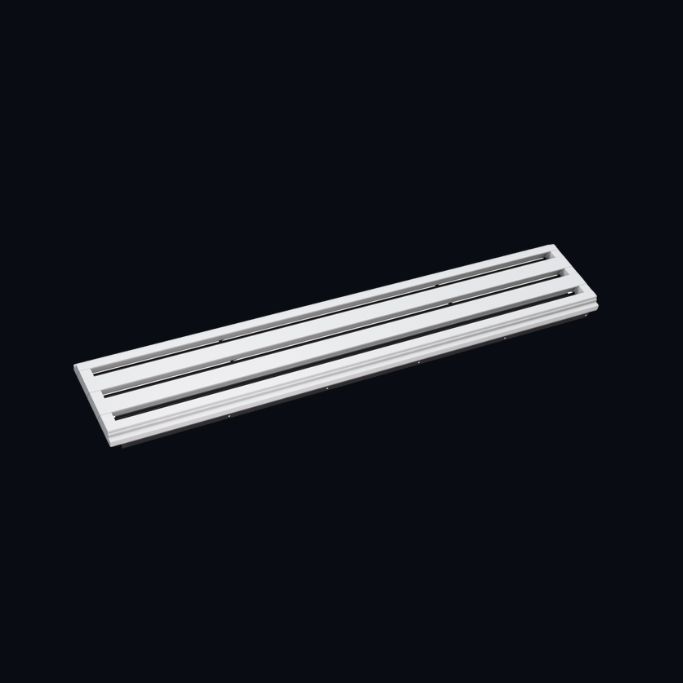
A metal grille — egg-crate, single or double deflection, linear bar, louvred — is an extruded or pressed aluminium or steel face in a visible frame, screwed or clipped into an opening. It is a mature, commoditised product. It works, it is cheap, it is available everywhere, and it looks like a grille.
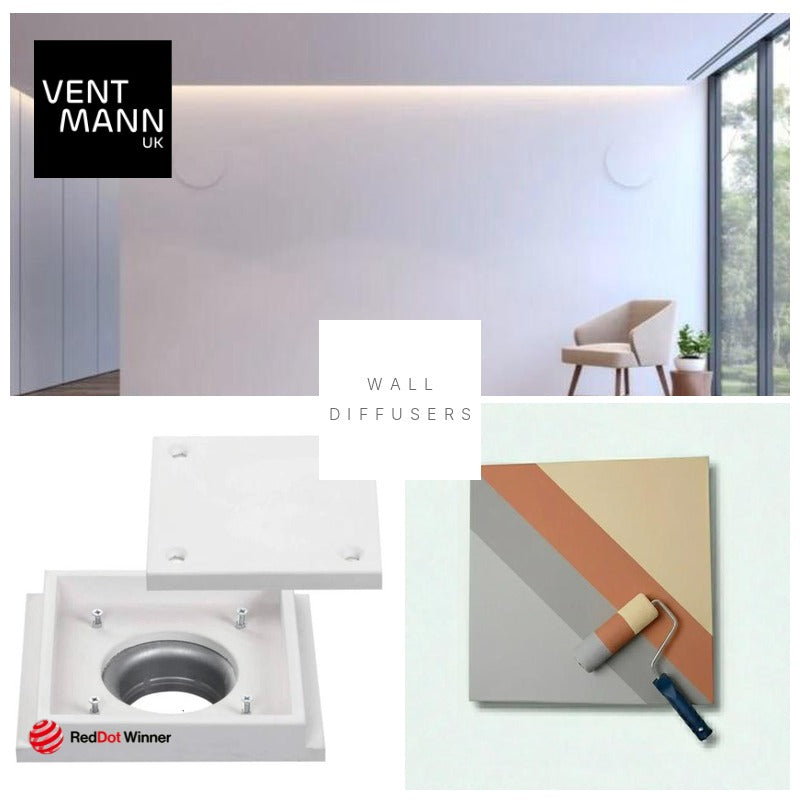
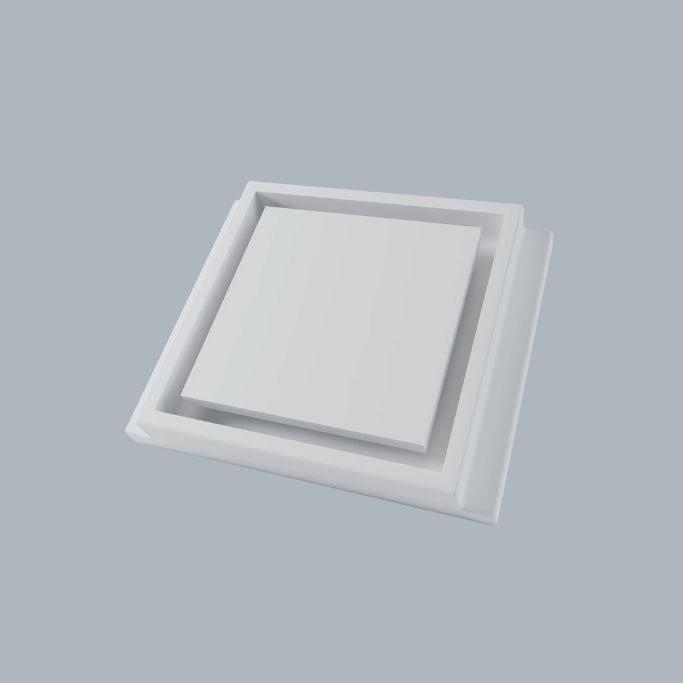
A frameless gypsum grille — the Ventmann Art range — is a gypsum-composite face over a laser-cut metal interior, held on industrial magnets, with no visible frame, screw or handle. It is jointed into the plasterboard and painted the same colour as the wall or ceiling. From a few metres away you see a pattern in the plaster, not a product.
The cost comparison, with labour in it
Comparing product prices alone flatters the metal grille and understates the gap. Comparing installed cost is fairer to both. Below is a single 300 × 200 mm outlet, built two ways.
| Line item | Standard metal grille | Ventmann Art frameless |
|---|---|---|
| Grille / face | £25–£70 typical trade | from £193.10 |
| Plenum / spigot box | £20–£60, or none | Art plenum from £92.00 |
| Fixing | Screws or spring clips, minutes | Magnetic, no fixings |
| Plasterer time | None — cut the opening | Jointing, taping, sanding — allow 20–40 min per outlet across two visits |
| Decorator time | Cut in around frame, or none | Painted with the wall — no extra, if done correctly |
| Programme risk | Low — fit at second fix | Must be set before boarding; 4–6 week lead time on Art |
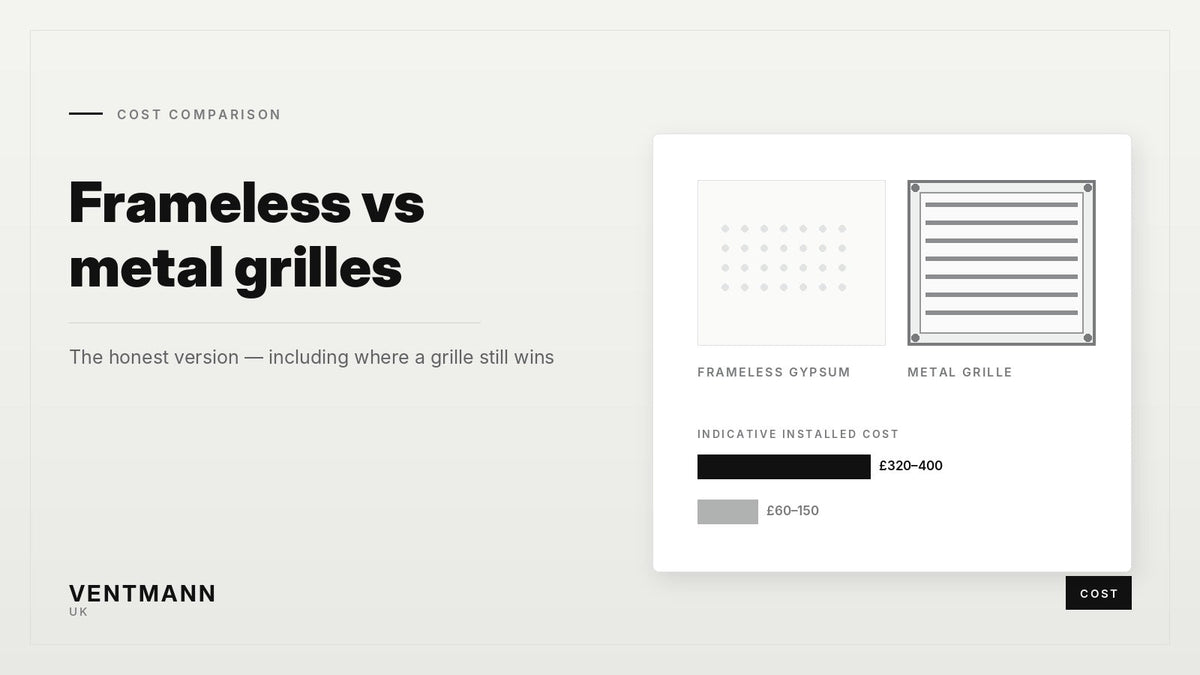
| Indicative installed | £60–£150 | £320–£400 |
Ventmann prices are published starting prices ex VAT at the time of writing; trade accounts take a further 10%. Metal grille prices and labour allowances are typical UK ranges and will vary with specification, region and quantity.
So the frameless option is in the region of two to five times the installed cost. On a single outlet that is a rounding error on a fit-out. On ninety outlets across a hotel it is a real number, and it deserves to be defended on the drawing rather than slipped into a schedule.
Where a metal grille is the right call
These are not grudging concessions. In each of these cases a metal grille is the better engineering answer and we would say so on the phone.
1. Anything behind a demountable ceiling
Suspended grid, lay-in tile, accessible plank — the whole point of the ceiling is that it comes down. A jointed, painted, plastered-in face fights that. Use a metal grille sized to the tile module.
2. Plant rooms, risers, back-of-house, undercrofts
Nobody is looking at it, it will be knocked, and somebody will want it off within five years. Spend the money where the client can see it.
3. Where regular access or inspection is required
Magnetic frameless faces do come off cleanly — that is one of the Art range's real strengths over a plastered-in diffuser — but if the access is routine and frequent, a screwed metal face with a proper hinged option is the correct detail.
4. Wet, washdown and heavy-duty environments
Commercial kitchens, swimming pool halls, laboratories, food production. Specify stainless or powder-coated aluminium that can be jet-washed and sterilised.
5. Where volume control is needed at the grille
If the commissioning strategy relies on an opposed blade damper behind the face, or on adjustable deflection blades, a metal grille does it natively. With a frameless face you balance upstream instead — an inline damper or an airflow regulator — which is perfectly workable but has to be designed in, not discovered at commissioning.
6. Tight programme or late design change
The Art range is made to order on a 4–6 week lead time and has to be in place before the boarding goes up. A metal grille is next-day and fits into an opening at second fix. If the decision is being made after first fix, that decides it for you.
7. High-volume, low-visibility repetition
Two hundred transfer grilles in corridor doors is a budget line, not a design feature. Treat it as one.
Where frameless earns the premium
The argument for frameless is not that it moves air better. It is that it removes an object from a surface the client has paid an architect to resolve.
- Feature walls and clean plaster planes. One white rectangle with visible screws undoes a wall. This is the single most common reason people find us.
- Fireplace and media walls. The Art range was designed partly for fireplace ventilation and inspection hatches, where the grille sits at eye level in the most looked-at surface in the room.
- Hospitality and high-end residential. Where the finish standard is the product. Hotel rooms, restaurants, prime residential, showrooms.
- Colour matching. The gypsum face takes the same paint as the wall, so it disappears in any scheme — including dark and deeply saturated colours, where a white metal grille is at its most obvious. More on this on our paintable vent grille page.
- Heritage and conservation work. Where visible modern services are the thing the planners object to.
A useful way to budget it: do not apply frameless across the whole project. Apply it to the rooms on the visuals, and use metal grilles everywhere else. A typical house or small commercial fit-out has eight to fifteen outlets that matter visually and thirty that do not. Splitting the specification that way usually gets the design past value engineering intact.
Things that are often claimed and are not true
"Frameless grilles are harder to clean." The Art face comes off on magnets with no tools and goes back without alignment. It is easier than unscrewing a painted-in metal frame.
"Gypsum will crack at the joint." It cracks if it is jointed badly, like any plasterboard junction. The composite is formulated to absorb water and take jointing compound, and the joint behaves like a board joint when it is scrimmed, filled and sanded properly. Our installation guidance covers the method.
"You cannot change it later." You can. The face is magnetic and the plenum stays in the void. What you cannot easily do is change your mind about type after the ceiling is closed — which is true of a metal grille's opening size too.
"Metal performs better." Not inherently. Performance comes from free area, plenum design and deflection geometry, not from the material of the face.
The decision, in one table
| If this is true | Specify |
|---|---|
| It appears on a visual or a sales image | Frameless |
| Solid plastered ceiling or wall, decided before boarding | Frameless |
| Dark or strongly coloured surface | Frameless |
| Demountable or accessible ceiling | Metal |
| Back-of-house, plant, riser, undercroft | Metal |
| Washdown, wet or heavy-duty | Metal |
| Damper or blade adjustment needed at the face | Metal |
| Decision made after first fix | Metal |
If you are specifying linear supply rather than a grille, the same logic applies one range along — see our comparison of Line, Performance Line and Performance Circle diffusers, or browse the full Art frameless range.
Want a straight answer on your project?
Send the outlet schedule. We will mark up which positions justify frameless and which do not, and price only the ones that do.
Request a free quotation · About frameless diffusers · +44 (0)1283 240025
Where to go next
- Line vs Performance Line vs Circle — the frameless ranges compared
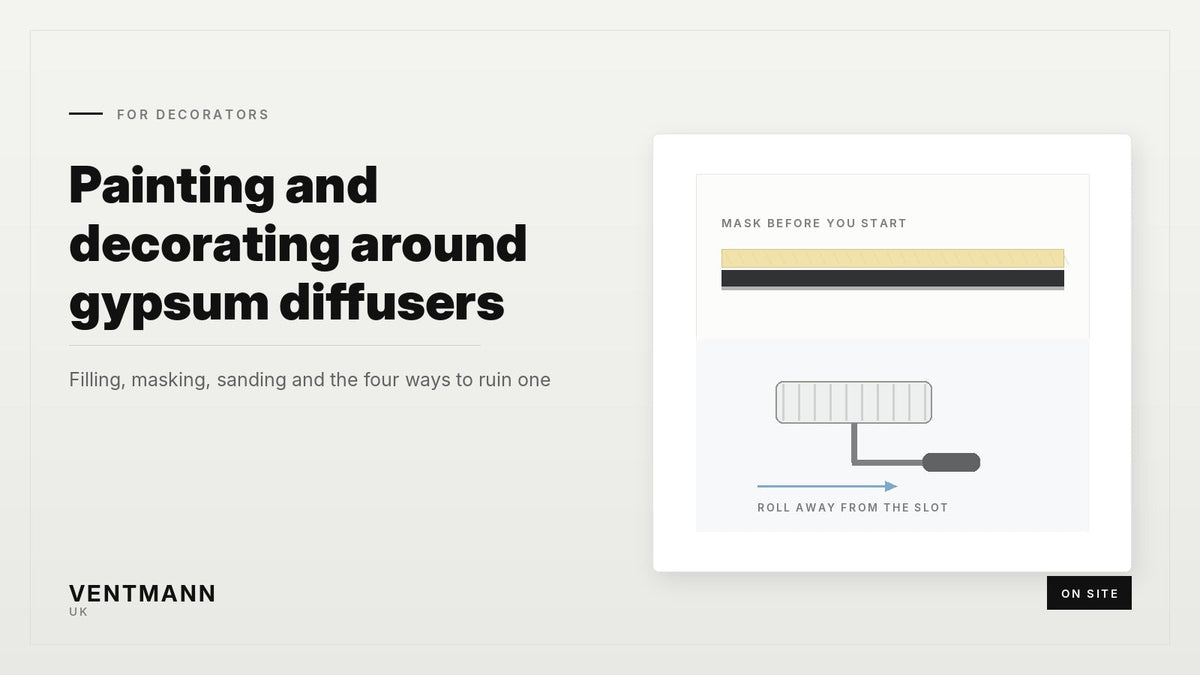
- Painting and decorating around gypsum diffusers — the labour side of the cost comparison
- Retail ventilation that disappears — where the visual argument is strongest
- Ventilation grilles for healthcare — where a metal grille is the correct answer
- Apartment schemes at scale — splitting the specification to survive value engineering