


MVHR Vents, Grilles and Ceiling Diffusers: Choosing the Right Terminal for Every Room

An MVHR unit is specified with care — heat recovery efficiency, fan power, filter class — and then the air reaches the rooms through whatever white plastic valves came in the box. The vents are the only part of the system anyone sees or hears, and they are usually the last thing anyone thinks about. This guide covers the MVHR vents, grilles and ceiling terminals available in the UK, how they differ, and which to use in each room.
Three things matter at the terminal: that it passes the design flow rate quietly, that nobody underneath feels a draught, and that it looks acceptable for the next twenty years. The standard air valve manages the first on a good day and neither of the others.
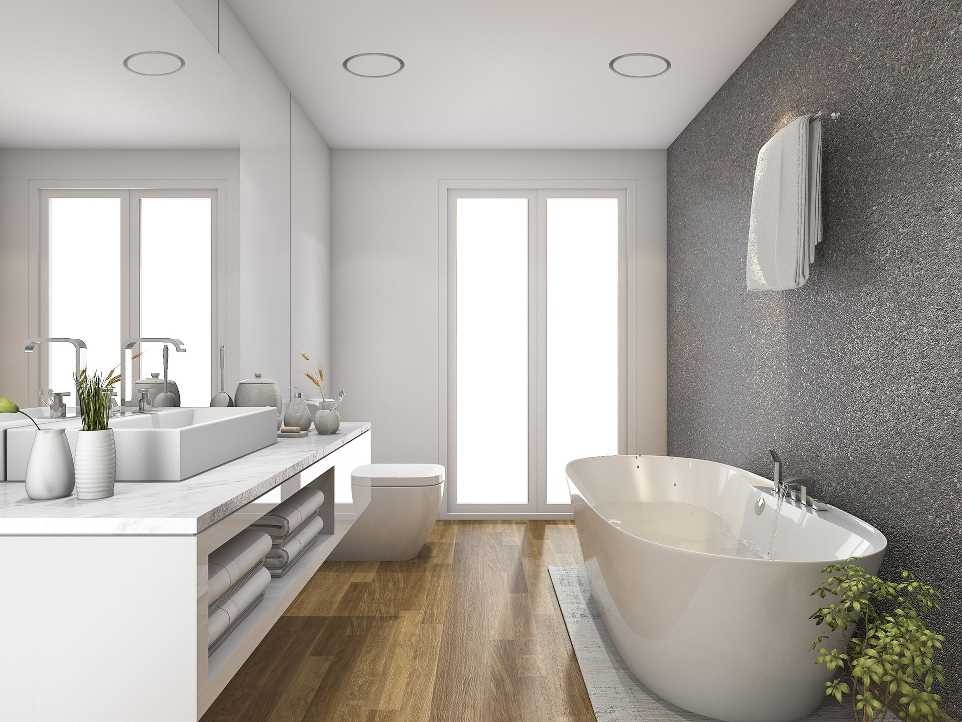
An extract terminal in a bathroom ceiling. On MVHR the extract points matter as much as the supplies.
The types of MVHR vent
| Terminal | What it is | Pros | Cons |
|---|---|---|---|
| Plastic air valve | Round cone valve, adjusted by screwing the centre in or out | Cheap, supplied with most units | Visible frame, whistles when closed down, yellows with age |
| Metal ceiling valve | Same geometry in painted steel | Looks better, more robust | Still framed; adjusting it changes both flow and noise |
| MVHR grille | Flat louvre or egg-crate face | Larger free area | Little diffusion; directional draught in supply rooms |
| Frameless gypsum diffuser | Plaster-in terminal painted with the ceiling | Invisible, quiet, Coanda air pattern, paintable | Needs a plasterboard ceiling or wall and a plenum/void |
Supply rooms: a Coanda pattern, not a jet
Supply terminals go in bedrooms and living rooms — the rooms where people are still for longest. A cone valve pushes air down in a ring; a Coanda diffuser attaches the air to the ceiling and spreads it across the room, so it has mixed with room air before it comes down at the walls. In a bedroom at 3 a.m. that is the difference between a system that stays on and one that gets switched off.

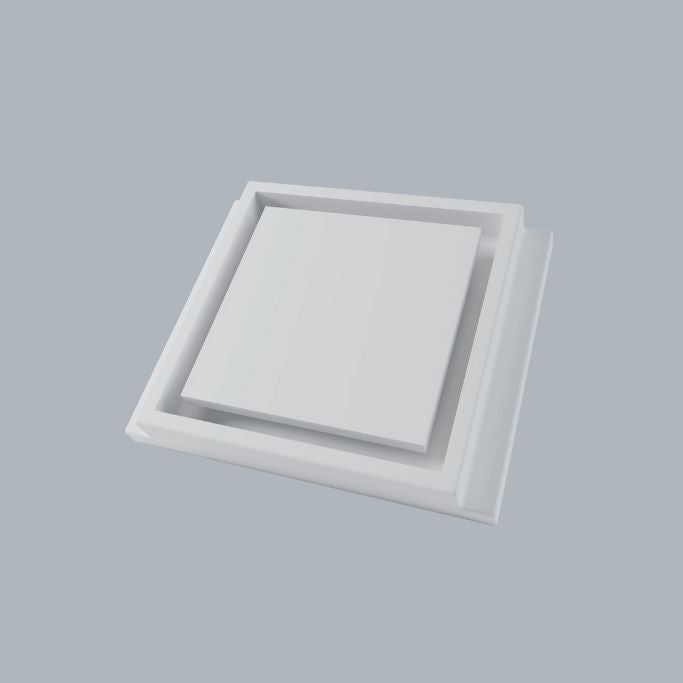
Performance Circle Diffusers
The circular frameless terminal. Curved internal geometry turns the supply air outwards along the surface (the Coanda effect), giving wide dispersal and almost no perceptible airflow directly below. Four spigot sizes cover everything from an MVHR bedroom branch to a cooled open-plan space.
- Shape Circular, frameless, plaster-in
- Slots 1 or 2
- Spigot sizes 100, 125, 160 and 200 mm
- Material Gypsum, supplied white, fully paintable
- Duty Supply or extract, heating and cooling
- Price From £86.65 excl. VAT
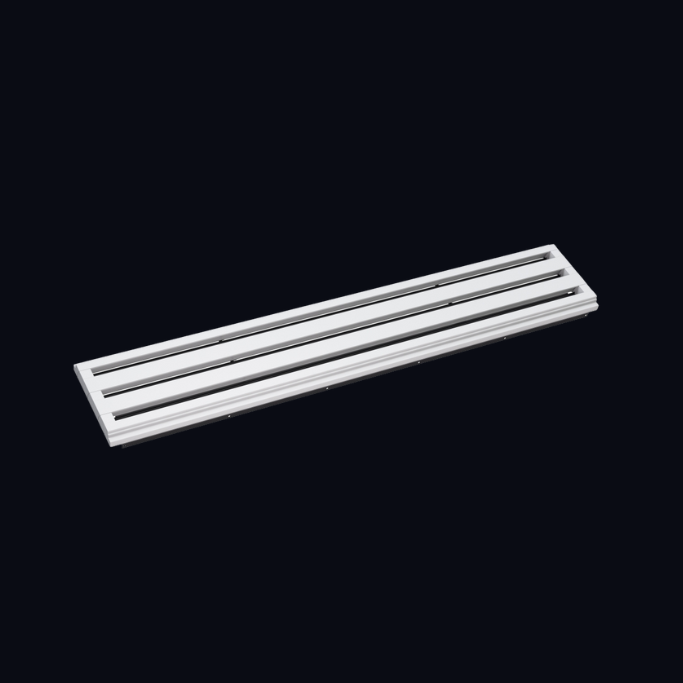
Where a room is served by a continuous architectural line rather than a single point — a kitchen-diner, an open-plan living space — the Line or Performance Line slot does the same job from a plenum box.
Extract rooms: the same terminal, pulling
Bathrooms, en-suites, utility rooms and kitchens on MVHR need an extract terminal each. The frameless diffusers work in both directions, so the extract points can match the supply points instead of being a different, cheaper product. In wet rooms the gypsum body is painted with a bathroom-grade emulsion like the rest of the ceiling.
No ceiling void? Use the wall
Loft rooms, solid-floor flats and retrofits often have no ceiling void to speak of. Wall-mounted supply vents are the answer: a frameless round or square terminal plastered into the wall high up, throwing air along the wall. Slots in walls use the shallow side-entry Thermo Box plenum.
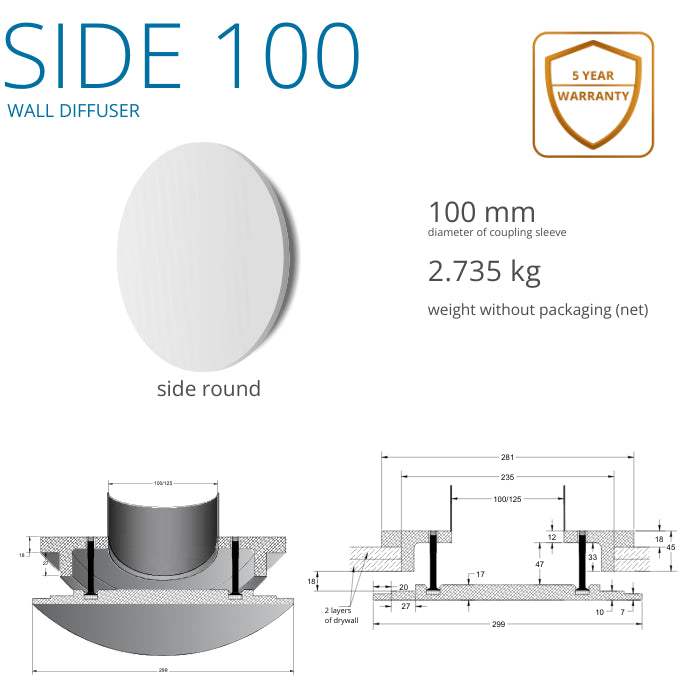
Side Round Diffuser
For rooms with no ceiling void. A frameless round terminal that plasters into a wall (or ceiling) and throws air along the surface, with an adjustable gap height to change the air speed. Five spigot sizes up to 250 mm.
- Spigot sizes 100, 125, 160, 200 and 250 mm
- Adjustment Gap height sets the airflow speed
- Mounting Wall or ceiling, plaster-in
- Material Gypsum, supplied white, fully paintable
- Price From £122.37 excl. VAT
MVHR ceiling valves versus frameless diffusers: the practical differences
- Balancing. A valve is balanced by closing its face, which raises face velocity and noise. A frameless diffuser is balanced in the duct with an inline foam damper, so the face stays open and quiet.
- Noise. Gradual, attached airflow through a profiled slot is quieter than a sharp-edged cone at the same flow. Pair it with acoustic ducting on the last run into bedrooms.
- Appearance. No frame, no yellowing plastic, no visible fixings. Painted with the ceiling.
- Installation. The valve is pushed into a plastic collar; the diffuser is fixed to the board and skimmed — a few extra minutes for the plasterer, nothing for the installer.
- Cost. More than a plastic valve, less than most designer metal valves, and the only option that genuinely disappears.

A linear slot supply in a living room. One terminal, the full length of the room, no frame.
Specifying MVHR terminals room by room
| Room | Duty | Terminal | Notes |
|---|---|---|---|
| Bedroom | Supply | Performance Circle 100 or 125 mm | Coanda pattern; acoustic duct on the final run |
| Living room / kitchen-diner | Supply | Performance Circle 125–160 mm, or Line slot with plenum | Slot for a continuous line; two-slot circle for higher duty |
| Bathroom / en-suite | Extract | Performance Circle 100 or 125 mm | Painted with bathroom emulsion |
| Kitchen | Extract | Performance Circle 125 mm or Square | Grease filter upstream per the MVHR manufacturer |
| Utility / WC | Extract | Square Diffuser 100 mm | Smallest footprint |
| Loft room / no void | Supply | Side Round or Side Square in the wall | Side-entry plenum for slots |
Passivhaus and low-energy homes
Passivhaus and other low-energy standards push supply air temperatures close to room temperature and flow rates down to the minimum, which makes draught-free, quiet terminals easier — and makes any noise more noticeable in a very quiet house. Frameless gypsum terminals are widely used on certified schemes for that reason; the Passivhaus ventilation guide covers the design side.
Reducing MVHR noise at the terminal
Most "noisy MVHR" complaints are terminal and duct problems rather than unit problems: a valve closed down to balance a branch, a rigid duct carrying fan noise straight into a bedroom, or a plenum with no lining. Open-faced diffusers balanced in the duct, acoustic ducting on the last metre, and a foam-lined plenum on slot terminals solve most of them. The MVHR noise guide goes through each fix.
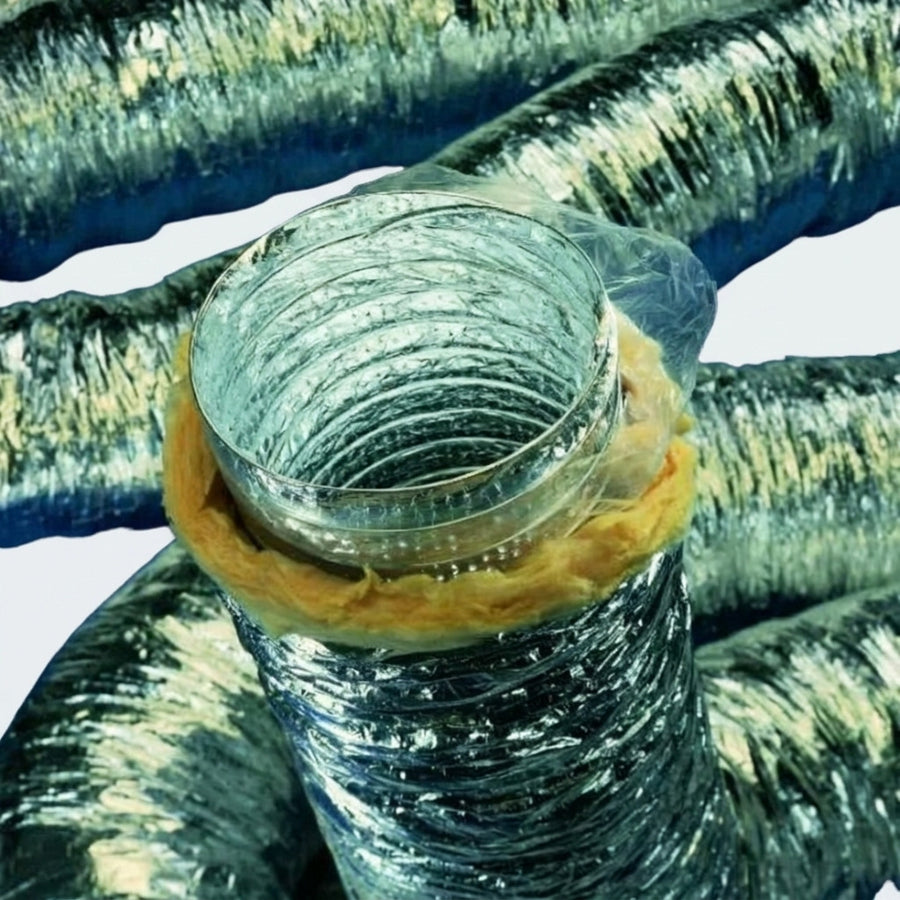
Acoustic Aluminium Flexible Ducting
For the last run into a bedroom, hotel room or office. A quiet terminal fed by a noisy duct is still a noisy room, and acoustic ducting also stops conversation carrying between rooms on the same branch.
- Sizes Six diameters
- Suitable for MVHR, air conditioning and HVAC
- Price From £35.72 excl. VAT
Frequently asked questions
What vents do you use with MVHR?
Supply terminals in habitable rooms and extract terminals in wet rooms, connected to 100 or 125 mm branches (larger for high duties). They can be plastic valves, metal valves, grilles or frameless plaster-in diffusers; the diffusers are the quiet, invisible option.
Do you need trickle vents with MVHR?
No. A balanced MVHR system supplies and extracts mechanically, so background trickle vents in windows are not required and work against the system by letting unconditioned air in. Follow Building Regulations Approved Document F and the system design.
Can MVHR vents go in the wall instead of the ceiling?
Yes. Wall-mounted supply vents are common in loft rooms and retrofits with no ceiling void; frameless Side Round and Side Square terminals throw the air along the wall.
How much does an MVHR ceiling diffuser cost?
Plastic valves cost a few pounds. Frameless gypsum diffusers start at £86.65 excl. VAT for the Performance Circle and £67.74 for the Square Diffuser, with a 5-year warranty.
How is a frameless MVHR diffuser installed?
The body is fixed to the plasterboard through side brackets, the duct connected to the spigot, the flange skimmed with jointing compound and the whole thing painted with the ceiling. The cut-out is the body diameter plus about 10 mm.
Do frameless diffusers reduce MVHR noise?
They help. A profiled slot or Coanda face is quieter than a cone valve at the same flow, and because they are balanced in the duct rather than by closing the face, the main source of valve noise is removed.
Not sure which terminal you need?
Send us your floor plan and we will run the airflow calculations, size every diffuser, plenum and damper, and get the kit to you with next-day UK delivery — free.
Call 01283 240025 · Email sales@ventmann.co.uk
Shop MVHR diffusersGet Free Airflow Calculations